
Intermittent Reinforcement: Definition & Psychology Explained
A clear, AP Psychology-style breakdown of intermittent reinforcement, definition, operant conditioning roots, and reinforcement schedules.
 Berry Bits
·
July 15, 2026
·
7 min read
Berry Bits
·
July 15, 2026
·
7 min read
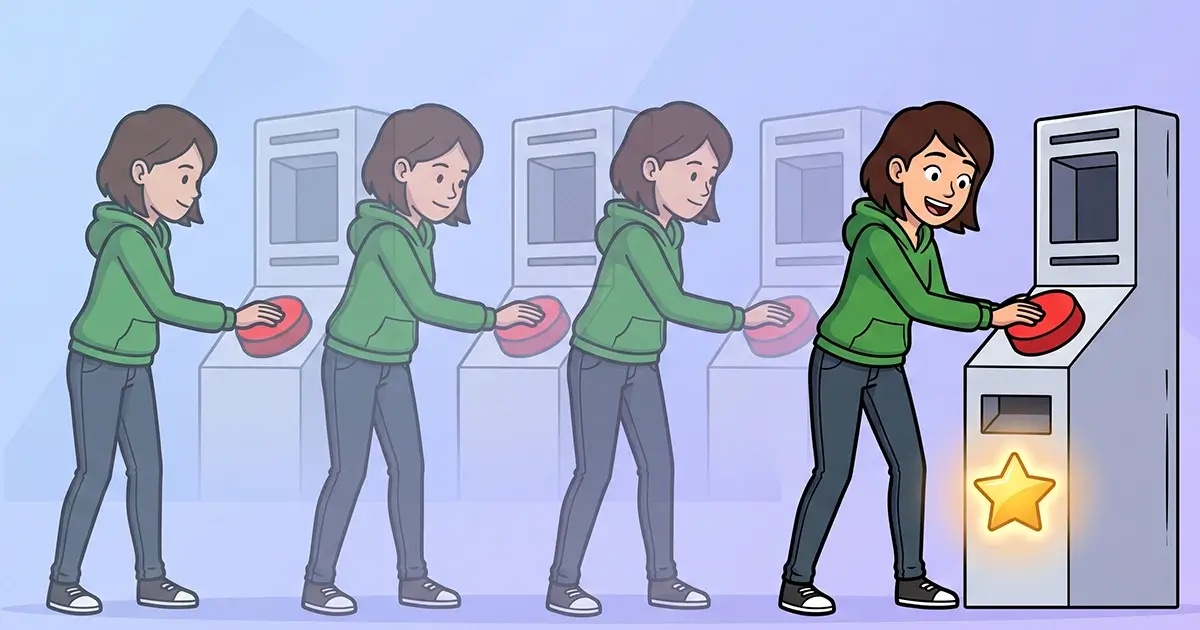
Have you ever wondered why people keep checking their phones even when there are no new notifications? Or why someone continues buying lottery tickets despite rarely winning?
The answer often lies in intermittent reinforcement—one of the most powerful concepts in behavioral psychology.
Understanding the intermittent reinforcement definition helps explain why certain habits become incredibly difficult to break. Whether you're studying AP Psychology, preparing for an exam, or simply curious about human behavior, this concept appears everywhere—from parenting and education to marketing, gaming, relationships, and social media.
In this guide, you'll learn what intermittent reinforcement is, how it works in operant conditioning, the four reinforcement schedules, four real-world examples, its advantages and disadvantages, and answers to the most common questions students ask.
What Is Intermittent Reinforcement?
The intermittent reinforcement definition is straightforward:
Intermittent reinforcement is a reinforcement schedule in which a desired behavior is rewarded only some of the time instead of every time it occurs.
Unlike continuous reinforcement, where every correct behavior receives a reward, intermittent reinforcement provides rewards unpredictably or after certain conditions are met.
This occasional rewarding strengthens behaviors while making them much more resistant to extinction.
Intermittent Reinforcement in Operant Conditioning
Intermittent reinforcement comes from operant conditioning, a learning theory developed by psychologist B.F. Skinner.
Operant conditioning suggests that behaviors are influenced by their consequences.
- Behaviors followed by rewards become more likely.
- Behaviors followed by punishment become less likely.
Once a behavior has been learned through continuous reinforcement, psychologists often switch to intermittent reinforcement to maintain the behavior over the long term.
For example, a teacher might praise every correct answer while introducing a new topic. After students understand the material, praise becomes less frequent, yet students continue participating because they have learned the behavior.
Why Is Intermittent Reinforcement So Effective?
One reason intermittent reinforcement works so well is uncertainty.
When people know that rewards only appear occasionally, they continue repeating the behavior because the next attempt might be the successful one.
This uncertainty keeps motivation alive.
It also explains why habits involving gambling, social media, online games, and even shopping can become difficult to stop.
Since rewards arrive unpredictably, people continue trying, expecting that the next action may produce a positive outcome.
The Four Types of Intermittent Reinforcement Schedules
Intermittent reinforcement is divided into four schedules.
Each rewards behavior differently.
1. Fixed Ratio Schedule
A reward comes after a specific number of responses.
Example:
A coffee shop gives customers one free drink after purchasing ten coffees.
The customer knows exactly when the reward will arrive.
2. Variable Ratio Schedule
Rewards occur after an unpredictable number of responses.
Example:
Slot machines pay out after varying numbers of plays.
Players never know when the next reward will come, making this one of the strongest reinforcement schedules.
3. Fixed Interval Schedule
The first correct behavior after a fixed amount of time receives reinforcement.
Example:
Employees receive paychecks every two weeks.
The reward depends on time rather than the number of actions.
4. Variable Interval Schedule
Rewards become available after varying lengths of time.
Example:
Teachers may give surprise quizzes throughout the semester.
Students stay prepared because they cannot predict when the quiz will occur.
Example 1: Social Media Notifications

Imagine posting a photo online.
Sometimes it receives dozens of likes within minutes.
Other times, almost nothing happens.
Because positive feedback is unpredictable, people continue checking their phones throughout the day.
Every notification provides a small reward, reinforcing the habit of repeatedly opening the app.
This is an excellent example of variable ratio reinforcement, where rewards arrive unpredictably.
Example 2: Playing the Lottery

Buying lottery tickets rarely results in winning.
However, occasional winners receive enormous rewards.
The possibility of a future jackpot motivates millions of people to continue purchasing tickets despite frequent losses.
The unpredictable nature of winning keeps the behavior going, making lotteries one of the clearest examples of intermittent reinforcement.
Example 3: Training a Dog

A dog learning to sit may initially receive a treat every single time.
Once the behavior becomes consistent, treats are given only occasionally.
Although rewards become less frequent, the dog continues obeying commands because it has learned that rewards still appear sometimes.
This technique helps maintain the behavior without requiring constant treats.
Example 4: Sales Bonuses at Work

A salesperson may not receive recognition after every successful sale.
Instead, bonuses might be awarded after reaching monthly goals or exceeding certain performance levels.
Since rewards come periodically rather than continuously, employees remain motivated to keep performing well over time.
Many workplaces intentionally use intermittent reinforcement because it encourages long-term effort.
Why Behaviors Become Hard to Stop
One fascinating feature of intermittent reinforcement is its resistance to extinction.
Extinction occurs when a learned behavior gradually disappears because rewards stop.
With continuous reinforcement, people quickly notice that rewards have ended and often stop the behavior.
With intermittent reinforcement, they have already experienced many unsuccessful attempts before receiving rewards.
As a result, they continue trying much longer, assuming another reward may still be coming.
This persistence explains many everyday habits.
Everyday Places You See Intermittent Reinforcement
Intermittent reinforcement appears in many areas of life.
Common examples include:
- Video games with random rewards
- Social media notifications
- Casino gambling
- Loyalty reward programs
- Sales commissions
- Surprise classroom quizzes
- Fishing
- Dating apps
- Promotional giveaways
- Children's behavior reward systems
Recognizing these patterns helps explain why certain activities become highly engaging.
Advantages of Intermittent Reinforcement
Intermittent reinforcement offers several important benefits.
Creates Long-Lasting Behaviors
Behaviors continue even when rewards become infrequent.
Reduces Reward Costs
Teachers, parents, and employers do not need to reward every successful action.
Builds Persistence
Individuals learn to continue working despite occasional disappointment.
Mimics Real Life
Many real-world rewards occur unpredictably, making this schedule practical and effective.
Disadvantages of Intermittent Reinforcement
Despite its effectiveness, intermittent reinforcement also has limitations.
Slower Learning
New behaviors usually take longer to establish compared to continuous reinforcement.
Can Encourage Unhealthy Habits
When used unintentionally, intermittent rewards may contribute to excessive gaming, gambling, or compulsive phone checking.
Less Predictable Motivation
Some people become discouraged if rewards are spaced too far apart.
Finding the right balance is important.
Intermittent Reinforcement in AP Psychology
Students studying AP Psychology should remember these key ideas:
- It is part of operant conditioning.
- Rewards are delivered only occasionally.
- Behaviors become more resistant to extinction.
- There are four reinforcement schedules.
- Variable ratio schedules typically produce the highest response rates.
Understanding these concepts makes many exam questions easier to answer.
Key Takeaways
The intermittent reinforcement definition describes rewarding behavior only some of the time rather than after every response.
Although learning may begin more slowly than with continuous reinforcement, behaviors maintained through intermittent reinforcement tend to last much longer.
From dog training and classroom learning to social media and casinos, this psychological principle explains why people continue repeating behaviors even when rewards are unpredictable.
For psychology students, understanding intermittent reinforcement provides a strong foundation for learning operant conditioning and behavioral science.
Frequently Asked Questions (FAQs)
What is the simple definition of intermittent reinforcement?
Intermittent reinforcement is a learning method in which a behavior is rewarded only occasionally instead of every time it occurs.
What is the difference between continuous and intermittent reinforcement?
Continuous reinforcement rewards every correct behavior, making learning faster. Intermittent reinforcement rewards behavior only sometimes, making the learned behavior more resistant to extinction.
What are the four types of intermittent reinforcement?
The four schedules are:
- Fixed Ratio
- Variable Ratio
- Fixed Interval
- Variable Interval
Each determines when reinforcement is delivered based on responses or time.
Why is intermittent reinforcement so powerful?
It creates uncertainty. Because individuals never know when the next reward will arrive, they continue repeating the behavior, making it highly resistant to extinction.
Is intermittent reinforcement positive or negative?
Intermittent reinforcement is neither inherently positive nor negative. It is simply a schedule for delivering reinforcement. Its effects depend on how it is used and the behavior being reinforced.
Who introduced intermittent reinforcement?
The concept was developed through the work of psychologist B.F. Skinner as part of his research on operant conditioning and behaviorism.
Can intermittent reinforcement be used in education?
Yes. Teachers often use intermittent reinforcement by offering praise, participation points, or rewards occasionally after students have learned a behavior. This helps maintain motivation while reducing dependence on constant rewards.
Final Thoughts
The concept of intermittent reinforcement demonstrates that rewards do not need to happen every time to shape behavior effectively. In fact, occasional and unpredictable rewards often produce stronger, longer-lasting habits than continuous reinforcement.
Whether you're preparing for an AP Psychology exam, exploring behavioral science, or trying to understand everyday habits, mastering the intermittent reinforcement definition will help you recognize how powerful reinforcement schedules influence human and animal behavior in daily life.




Comments (0)
No comments yet. Be the first to share your thoughts!
Leave a comment
Your comment will appear after it's reviewed. Your email is never shown publicly.