
Scarcity Principle Explained: Why “Last One Left” Drives FOMO Buying
The Scarcity Principle explains how limited availability increases perceived value and triggers urgency in decision-making. When people believe something is running out, they shift from logical evaluation to emotional reactions driven by fear of missing out, often leading to impulse purchases.
 Berry Bits
·
May 13, 2026
·
6 min read
Berry Bits
·
May 13, 2026
·
6 min read
Scarcity Principle Explained in Depth (With Real Examples)
Introduction to the Scarcity Principle
The Scarcity Principle is one of the most powerful psychological triggers used in marketing and human decision-making. It explains how people tend to assign higher value to things that are limited, rare, or perceived to be running out. This is not necessarily based on the actual usefulness or quality of the product, but rather on its availability.
When something is scarce, the human brain automatically interprets it as more desirable. This effect is deeply rooted in evolutionary psychology, where limited resources often meant higher survival value. Today, this ancient survival instinct still influences how we shop, choose, and react to opportunities.
How Scarcity Affects Decision Making
Under normal conditions, decision-making is relatively rational. A person evaluates price, need, quality, and alternatives before making a purchase. However, scarcity disrupts this process.
When scarcity is introduced, such as “only one left in stock” or “limited time offer,” the brain shifts its focus. Instead of asking whether the product is worth it, the mind starts asking whether the opportunity will disappear. This creates a psychological tension between logic and urgency.
At this point, emotional thinking begins to dominate rational thinking. The fear of regret becomes stronger than the desire for careful evaluation. People begin to act quickly, often without fully analyzing the decision.
The Role of Fear of Missing Out (FOMO)
Fear of Missing Out, commonly known as FOMO, is closely connected to the Scarcity Principle. It describes the anxiety people feel when they believe others might get something they cannot.
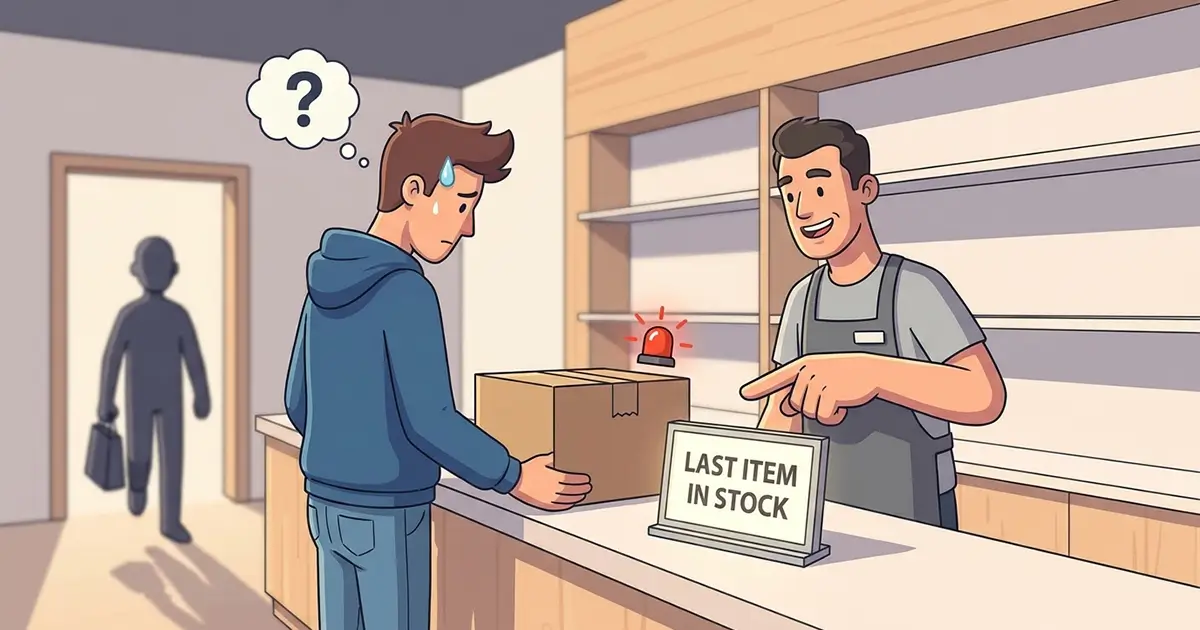
In your video script example, this is clearly demonstrated when the staff mentions that another customer is already interested in the same item. Even though the product itself has not changed, the introduction of competition instantly increases its perceived value.
FOMO creates urgency. It pushes people to make faster decisions because they want to avoid the emotional discomfort of missing an opportunity. This is why scarcity-based messages are so effective in both physical and digital environments.
Why Scarcity Works So Strongly on the Human Brain
Scarcity works because of a cognitive bias known as loss aversion. Humans are naturally more sensitive to losses than gains. Losing something feels more painful than gaining something of equal value feels rewarding.
When a product is presented as limited, the brain reframes the decision. It is no longer about gaining a product; it becomes about avoiding loss. This subtle shift is what makes scarcity so powerful in influencing behavior.
The brain also tends to assign higher attention to urgent signals. Anything that suggests limited time or availability is treated as high priority, which reduces hesitation and increases impulsive behavior.
Scarcity in Marketing and Real Life
Scarcity is widely used in marketing strategies across industries because of its consistent effectiveness. Retailers, e-commerce platforms, and luxury brands all use scarcity-based messaging to influence customer behavior.
For example, online shopping platforms often display messages like “only 2 items left” or “selling fast.” These statements are designed to create urgency, even if inventory is not actually critically low.
Similarly, limited edition products are released to create exclusivity. The idea that only a few people can own something increases its perceived value significantly. This is why sneakers, collectibles, and luxury items often sell out quickly, even at high prices.
Event ticketing systems also use scarcity effectively. When users see that seats are filling up or prices are increasing, they are more likely to make immediate purchases rather than delay.
The Psychological Mechanism Behind the Script
In your script, the customer initially hesitates due to price concerns. At this stage, the decision is still logical. However, the moment scarcity is introduced, the entire decision-making framework changes.
The idea that the item is the last one in stock immediately increases its perceived value. The introduction of another interested buyer further intensifies the urgency. This creates a competitive environment in the customer’s mind.
Even though the actual product remains unchanged, its psychological value increases dramatically. This demonstrates a key principle of behavioral psychology: perception often matters more than reality in decision-making.
Perceived Scarcity vs Real Scarcity
One of the most interesting aspects of the Scarcity Principle is that it does not require actual scarcity to be effective. Perceived scarcity alone can produce the same psychological response.
For example, a product may still have sufficient stock, but if customers believe it is running out, they are still likely to act quickly. This is why marketing messages are often framed in ways that suggest urgency or exclusivity.
However, this also raises ethical considerations. While scarcity can be a legitimate business strategy, it can also be used manipulatively if it creates false urgency.
Real-World Examples of Scarcity
Scarcity is present in many everyday experiences. Flash sales on e-commerce platforms create time-limited urgency. Concert tickets often sell out quickly due to perceived limited availability. Even social media trends can create scarcity-like pressure when users feel they must engage before something becomes irrelevant.
These examples show that scarcity is not limited to retail environments. It is a broader psychological principle that affects nearly all areas of decision-making.
Conclusion
The Scarcity Principle demonstrates how human behavior can be influenced by perception rather than objective reality. When something feels limited, it automatically becomes more valuable in our minds. This leads to faster decisions, increased urgency, and often impulsive behavior.
Understanding this principle helps consumers become more aware of how marketing influences their decisions. It also highlights the importance of pausing and evaluating whether urgency is real or artificially created.
FAQs
1. What is the Scarcity Principle in simple terms?
The Scarcity Principle means people value things more when they are limited or hard to get.
2. Why does scarcity increase demand?
Because limited availability creates urgency and fear of missing out, which pushes people to act quickly.
3. Is scarcity always real in marketing?
Not always. Sometimes scarcity is real (limited stock), and sometimes it is perceived or strategically framed to increase urgency.
4. What is FOMO in psychology?
FOMO stands for Fear of Missing Out. It is the anxiety people feel when they think others might get something they cannot.
5. How does scarcity affect buying behavior?
It reduces rational thinking and increases emotional decision-making, often leading to impulse purchases.
6. Is the Scarcity Principle ethical in marketing?
It depends on usage. Real scarcity is ethical, but misleading or fake urgency can be manipulative.
7. Where do we see scarcity in real life?
We see it in sales, limited edition products, tickets, flash deals, and even social media trends.




Comments (0)
No comments yet. Be the first to share your thoughts!
Leave a comment
Your comment will appear after it's reviewed. Your email is never shown publicly.