
Doorway Effect Explained: Why You Forget What You Were Doing
The doorway effect explains why you forget what you were doing after entering a new room or switching context. Learn why it happens with real examples.
 Berry Bits
·
May 24, 2026
·
4 min read
Berry Bits
·
May 24, 2026
·
4 min read
The Doorway Effect: Why You Forget What You Were Doing
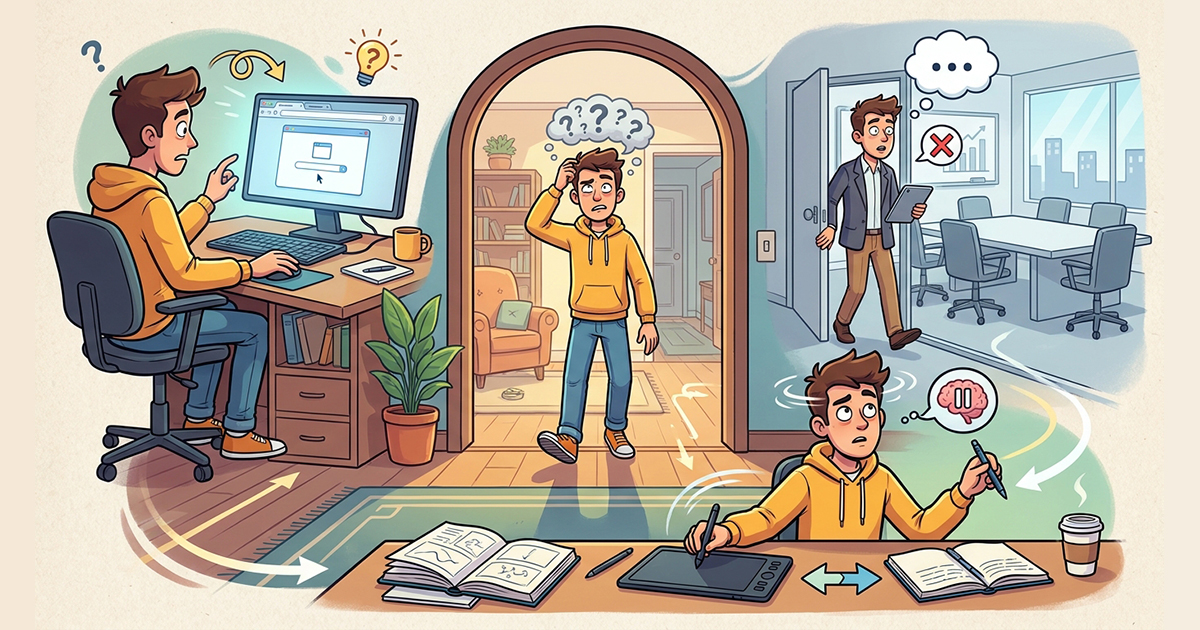
You walk into a room, stop for a second, and suddenly your mind goes blank. You were sure you had a reason for coming in, but it disappears completely. You stand there trying to retrace your thoughts, sometimes even walking back to where you started just to “recover” the idea.
This common experience is known in psychology as the doorway effect. It is a fascinating quirk of human memory that shows how sensitive our thoughts are to changes in environment and context.
What is the Doorway Effect?
The doorway effect refers to the tendency to forget thoughts or intentions when moving from one environment to another. In simple terms, your brain treats each new space as a separate “mental chapter,” and sometimes it files away the previous thought when you cross that boundary.
Researchers suggest this happens because the brain organizes memories based on context. When that context changes, the memory becomes slightly harder to access, even if it is still there.
This does not mean anything is wrong with your memory. It is a normal cognitive process tied to how attention and context work together in the brain.
Why Does It Happen?
Your brain is constantly filtering information. It prioritizes what is relevant “right now” based on your surroundings. When you move through a doorway or switch environments, your brain updates its context model.
This shift can cause what you were thinking about just seconds ago to become less accessible because it belonged to a slightly different mental setting.
It is less about forgetting and more about temporary retrieval disruption.
Example 1: Walking into a Room

You go to your kitchen to grab scissors. Halfway through, you get distracted by something else. You enter the kitchen and suddenly stop, thinking, “Why did I come here?”
The change in environment signals your brain that a new context has started. The original intention gets pushed down in priority, making it harder to recall instantly.
Example 2: Opening a New Browser Tab

You open your laptop intending to search for something specific. Before typing, you click a new tab or see a notification. A few seconds later, your original thought is gone.
Digital environments also trigger the same effect. Switching tabs creates a mini context shift, and your brain treats it like a new task, interrupting the original thought thread.
Example 3: Entering a Meeting Room

You walk into a meeting room ready to share an idea or ask a question. As soon as you sit down and look at everyone, your mind goes blank.
Social and environmental pressure adds extra cognitive load. The new setting plus attention shift makes it harder to retrieve what you were about to say.
Example 4: Switching Tasks Mid-Thought

You are writing an email, then quickly switch to replying to a message. When you return to the email, you forget the sentence you were about to type.
This is not just distraction. It is your brain reorganizing focus based on the new task, temporarily lowering access to the previous one.
Is the Doorway Effect Harmful?
In most cases, no. The doorway effect is completely normal and happens to almost everyone. It is not a sign of memory loss or cognitive decline.
It becomes more noticeable when you are tired, stressed, or multitasking heavily because your brain has fewer resources to maintain multiple thought threads.
How to Reduce It
While you cannot eliminate it completely, you can reduce how often it happens:
- Pause before switching environments and repeat your intention silently
- Avoid multitasking when forming a new thought
- Use quick mental cues like keywords (“scissors,” “email idea”)
- Stay focused on one task before moving to the next
These small habits help anchor your intention more strongly in memory.
Final Thought
The doorway effect is a reminder that human memory is deeply tied to context. We do not just store thoughts in isolation; we store them within environments, emotions, and attention states.
So the next time you walk into a room and forget why you are there, it is not your memory failing. It is just your brain doing what it is designed to do.

Comments (0)
No comments yet. Be the first to share your thoughts!
Leave a comment
Your comment will appear after it's reviewed. Your email is never shown publicly.