
Crisis Exploitation Explained: How Fear and Inflation Turn into Profit Systems
Crisis exploitation explained with real-world examples of how fear, inflation, war, and uncertainty are used to shape markets, pricing, and public behavior. Learn the psychology behind it.
 Berry Bits
·
June 18, 2026
·
6 min read
Berry Bits
·
June 18, 2026
·
6 min read
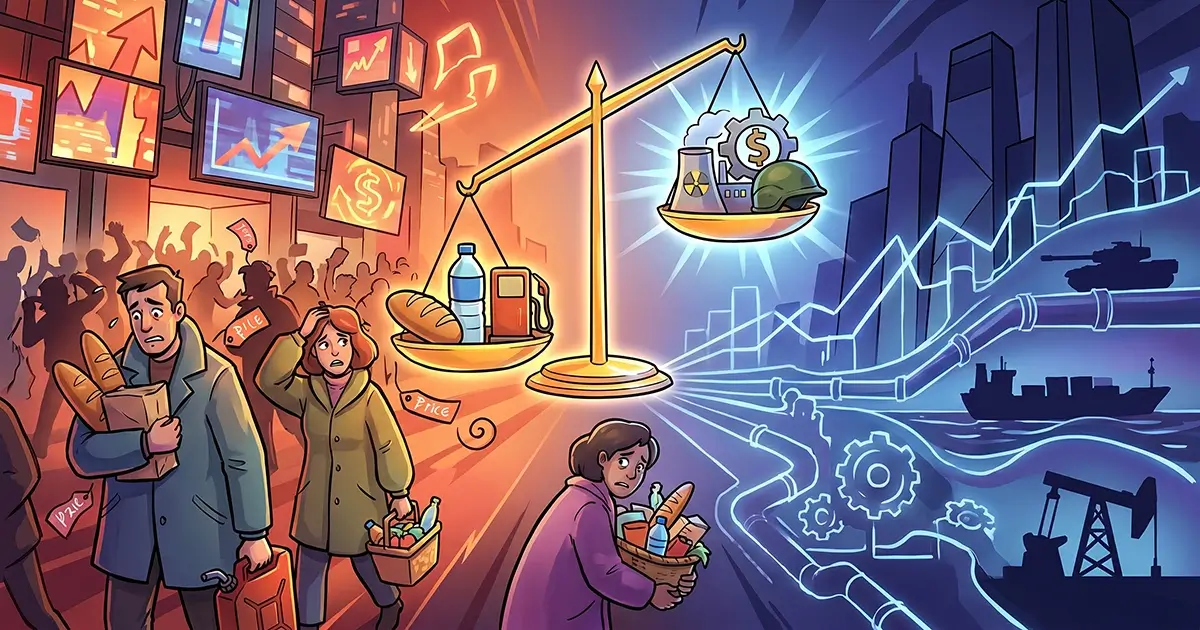
Crisis exploitation is the process where uncertainty, fear, or large-scale disruption is used, intentionally or structurally, to generate economic, political, or strategic advantage. It does not always require a single “villain” pulling strings. Often, it emerges from systems where panic, scarcity, and urgency reshape how people behave and how markets respond.
When people feel unstable, they make faster decisions. When systems feel unstable, prices adjust faster. This gap between fear and decision-making is where crisis exploitation lives.
It can appear in inflation cycles, war economies, supply chain shocks, or even media narratives that amplify urgency. Understanding it is less about conspiracy and more about recognizing patterns in how human behavior interacts with systems under stress.
Example 1: Inflation Shock and Price Acceleration

One of the clearest forms of crisis exploitation appears during inflation spikes.
When inflation begins, businesses face rising costs in raw materials, transport, or energy. That part is real. But what often follows is something more complex: prices rising faster than costs.
This happens because inflation creates psychological permission to raise prices. Businesses anticipate future cost increases and adjust early. Consumers, expecting continued price hikes, start panic-buying. That behavior reinforces scarcity, which then justifies further price increases.
For example, during global inflation periods, everyday goods like flour, cooking oil, or fuel may rise in price beyond immediate cost changes. The “fear of future shortages” becomes part of the pricing logic.
This is crisis exploitation through expectation. The crisis is not only economic; it becomes psychological.
Example 2: Supply Chain Disruption and Artificial Scarcity Effects

Global supply chains are complex and fragile. When they break, even slightly, the effects can ripple across industries.
During disruptions like port delays, geopolitical tensions, or shipping shortages, certain products become temporarily harder to obtain. In theory, prices should stabilize once supply normalizes. In practice, however, businesses often maintain higher prices longer than necessary.
This is where exploitation can emerge structurally.
Retailers and suppliers may frame limited availability as ongoing scarcity rather than temporary disruption. Consumers, already uncertain, accept higher prices as the “new normal.”
A classic example is electronics and automotive parts during global shipping disruptions. Shortages created long waiting times, but prices often stayed elevated even after supply improved.
The crisis becomes a pricing baseline rather than a temporary event. That shift is subtle, but powerful.
Example 3: War Economies and Strategic Pricing Power

re extreme environments where crisis exploitation becomes more visible, though still complex.
During wars or geopolitical tensions, energy markets, food exports, and logistics systems become unstable. This instability creates volatility in oil prices, grain exports, and transportation costs.
But beyond raw economics, perception plays a major role. Markets react not only to actual supply changes but also to anticipated risk.
For instance, when conflict threatens key shipping routes or energy-producing regions, global fuel prices can rise rapidly even before physical supply is significantly affected.
At the same time, companies positioned within essential sectors may experience increased demand or pricing flexibility. Governments may introduce controls, subsidies, or strategic reserves, but the short-term window often allows significant profit shifts.
This does not imply a single coordinated actor. Instead, it reflects how systems respond to fear-driven forecasting. The “expectation of disruption” itself becomes economically valuable.
Example 4: The “Bullet or Bread” Economy During Crisis Narratives

This example reflects the idea presented in your video concept.
During periods of global tension, crisis narratives often polarize into survival themes: security versus survival, defense versus daily needs, stability versus scarcity.
In such environments, attention and urgency become powerful economic tools.
For example, when public discourse centers around war risk, inflation panic, or systemic collapse, consumer behavior shifts toward immediate survival thinking. People prioritize essentials, delay long-term investments, and respond more strongly to urgency-based messaging.
This creates a feedback loop where fear-based narratives influence spending behavior, and spending behavior reinforces those narratives.
In extreme versions, economies begin to reflect “priority hierarchies” where defense spending, energy control, and food pricing dominate public attention. Meanwhile, everyday consumer goods become secondary in both policy and perception.
The phrase “bullet or bread” symbolizes this tension. It reflects how societies under pressure must balance survival infrastructure with daily living needs, and how that balance can be influenced by perception, media framing, and economic strategy.
This is crisis exploitation at a narrative level, where attention itself becomes part of the economic system.
How Crisis Exploitation Works Across All Examples
Across all four cases, a pattern emerges.
- First, a disruption occurs. It may be inflation, supply chain breakdown, war, or uncertainty.
- Second, fear spreads faster than facts. People react to what might happen, not just what is happening.
- Third, behavior shifts. Buying patterns change, prices adjust, and institutions respond to perceived risk.
- Finally, the new state often becomes semi-permanent. Temporary shocks turn into long-term pricing structures or behavioral norms.
Crisis exploitation is not always intentional manipulation. It can also be a structural outcome of how markets and human psychology interact under pressure.
The Psychology Behind It
At the core of crisis exploitation is behavioral psychology.
Humans are loss-averse. We react more strongly to potential loss than equivalent gain. During crises, this bias intensifies.
This leads to:
- Faster purchasing decisions
- Higher tolerance for price increases
- Reduced comparison shopping
- Increased reliance on authority or trending narratives
These behaviors collectively create fertile ground for economic shifts that feel “inevitable,” even when they are partially shaped by perception.
Can Crisis Exploitation Be Avoided?
Completely avoiding it is unrealistic because it is tied to how systems respond to uncertainty. However, awareness reduces its impact.
When people understand that fear accelerates pricing cycles and decision-making, they can pause long enough to evaluate whether a change is structural or psychological.
At a larger level, transparency in pricing, supply chains, and policy decisions can reduce the gap between perception and reality.
FAQs
What is crisis exploitation in simple terms?
It is when fear, uncertainty, or disruption leads to behaviors and systems that increase prices, shift demand, or create economic advantage from unstable conditions.
Is crisis exploitation always intentional?
No. It can be intentional in some cases, but often it emerges naturally from how markets and human psychology respond to crisis conditions.
How does inflation relate to crisis exploitation?
Inflation can amplify fear, causing people and businesses to act preemptively, which often pushes prices higher than immediate cost increases justify.
Why do prices stay high after crises end?
Because new “normal” expectations form during the crisis, and both businesses and consumers adjust their behavior around those higher price levels.
What is the psychological trigger behind crisis exploitation?
Fear of loss and uncertainty are the main triggers. People prioritize safety and immediacy over long-term rational comparison.
Conclusion
Crisis exploitation is not a single event or actor. It is a pattern that emerges when fear, economics, and human behavior intersect. Whether it appears in inflation cycles, supply disruptions, war economies, or narrative-driven urgency, the outcome is similar: systems shift faster than stability returns.
Understanding this does not eliminate crises, but it changes how we respond to them.




Comments (0)
No comments yet. Be the first to share your thoughts!
Leave a comment
Your comment will appear after it's reviewed. Your email is never shown publicly.