
Compassion Fatigue & Information Overload: Why Your Mind Feels Numb
Understand compassion fatigue, information overload, and burnout. Learn why your brain shuts down under constant digital stress and how to cope effectively.
 Berry Bits
·
June 16, 2026
·
6 min read
Berry Bits
·
June 16, 2026
·
6 min read
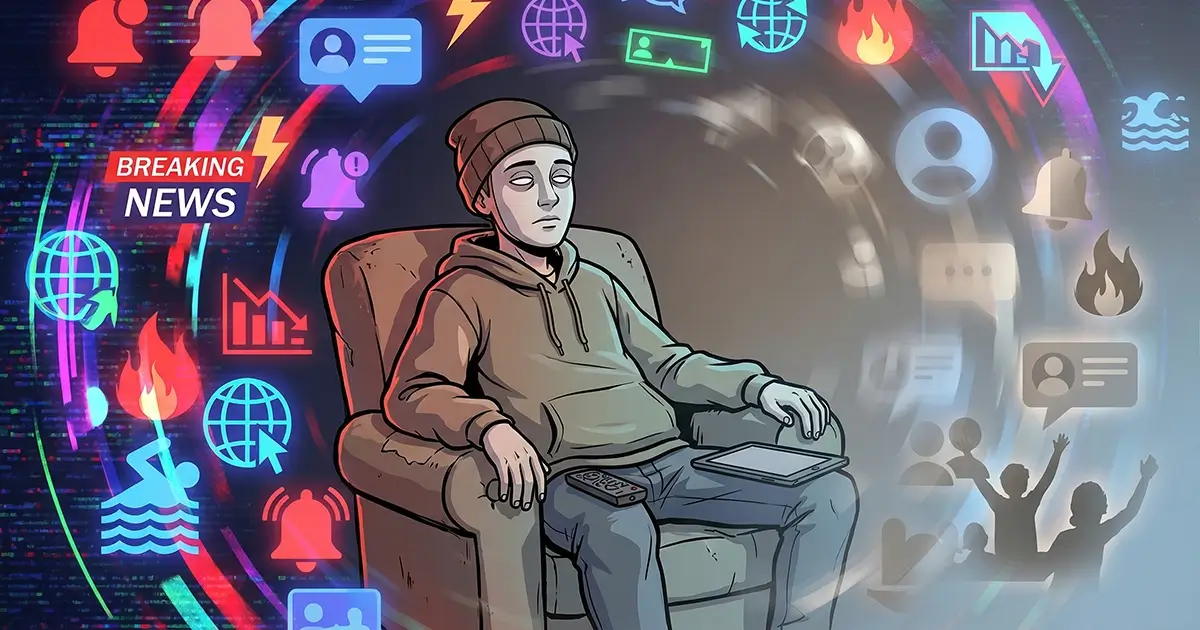
We are living in a time where information never stops. News updates, social media notifications, work messages, global crises, and personal responsibilities all compete for attention at the same time. On the surface, it feels like being “informed” is a good thing. But psychologically, there is a hidden cost.
When the human brain is exposed to too much emotional and informational input, it doesn’t become more aware or more empathetic. Instead, it starts to shut down. This state is often described as compassion fatigue or emotional overload. It is not a sign of weakness. It is a protective mechanism.
Understanding this is important because many people mistake emotional numbness for laziness, ignorance, or lack of care. In reality, it is often the opposite: caring too much, for too long, without enough recovery.
What Is Compassion Fatigue?
Compassion fatigue is a psychological response that occurs when a person is repeatedly exposed to distressing information or emotional content. It is commonly seen in healthcare workers, caregivers, and people constantly exposed to suffering through media.
But today, it is no longer limited to professionals. Anyone with a smartphone can experience it.
Your brain begins to reduce emotional responsiveness as a defense mechanism. This is why you might scroll past tragic news that once deeply affected you, or feel emotionally “flat” even when you know something is important.
It is not that you stop caring. It is that your emotional system is overloaded.
Why the Brain Isn’t Built for Constant Input
The human brain evolved in an environment where information was limited, local, and immediate. You would hear about events in your village, not global disasters happening simultaneously across the world.
Now, within minutes, you can see:
- Natural disasters across continents
- Financial crises affecting millions
- Personal updates from hundreds of people
- Breaking news every few seconds
Your brain treats emotional information as something requiring processing and response. But when everything feels urgent, nothing can be prioritized properly.
Eventually, the system starts filtering by shutting down emotional engagement altogether.
Example 1: Workplace Communication Overload

Imagine a modern office worker who is constantly connected to Slack, email, and project management tools.
Every few minutes:
- A message pops up from a team member
- An urgent email demands attention
- A deadline reminder appears
- A meeting invite interrupts focus
At first, the person tries to respond to everything quickly. But over time, the constant interruptions create cognitive fragmentation. The brain never fully settles into deep focus.
Eventually, the worker starts ignoring notifications just to function. Even important messages begin to feel like noise.
This is not laziness. It is mental exhaustion caused by continuous task-switching.
Example 2: Social Media and Emotional Scrolling

Now consider someone scrolling through social media.
In a single session, they might see:
- A funny meme
- A heartbreaking accident video
- A political argument
- A friend’s vacation photos
- A fundraising appeal for a crisis
Each post demands a different emotional response. Joy, sadness, anger, empathy, comparison, and frustration all appear within minutes.
At first, the emotional swings are sharp. But over time, the brain adapts by flattening response. Tragedy no longer shocks. Joy feels muted. Everything starts blending into a neutral scroll.
This emotional flattening is a key sign of compassion fatigue.
Example 3: Student Under Constant Academic Pressure

A student preparing for exams is already under pressure. Now add digital distractions.
They are:
- Watching lectures online
- Receiving study group messages
- Getting exam reminders
- Seeing peers post achievements
- Following educational content on multiple platforms
Instead of focused learning, their attention is split into fragments. Even during rest, their mind is still processing academic pressure through notifications.
Soon, the student may feel mentally stuck. They sit with books open but cannot absorb anything. They may label themselves as “unmotivated,” but the real issue is cognitive overload.
The brain has reached its processing limit.
Example 4: Global Crises, Economic Stress & Digital Noise

This is the modern condition many people quietly experience.
In one day, a person may be exposed to:
- Global tragedies happening in real time
- Economic instability and financial anxiety
- Personal responsibilities and family stress
- Continuous breaking news alerts
- Social media debates and emotional content
Each piece of information feels important on its own. But together, they create an unending stream of emotional pressure.
Over time, something subtle happens. The mind stops reacting strongly. Not because the person doesn’t care, but because caring about everything becomes unsustainable.
This is where emotional numbness sets in. It is not detachment from reality. It is a survival response to too much reality at once.
The Psychological Mechanism Behind Shutdown
When the brain is exposed to repeated emotional stimuli without recovery, it activates protective filtering systems.
This includes:
- Reduced emotional sensitivity
- Selective attention (ignoring inputs)
- Cognitive fatigue
- Decision paralysis
Essentially, the brain prioritizes survival over empathy. It chooses to conserve energy rather than process every emotional input.
This is why people often say they feel “burnt out,” “empty,” or “disconnected” after long periods of digital exposure.
How to Cope With Information Overload
There is no need to disconnect completely from the world. The goal is balance.
1. Reduce Input Intentionally
Limit exposure to news and social media at set times instead of constant checking.
2. Create Emotional Boundaries
Not every tragedy requires immediate emotional engagement. It is okay to acknowledge without absorbing.
3. Allow Mental Recovery Time
Boredom and silence are not empty states. They are necessary recovery periods for the brain.
4. Prioritize Depth Over Volume
Engage deeply with fewer sources of information rather than consuming everything superficially.
5. Recognize Early Signs of Fatigue
Emotional numbness, irritability, and lack of focus are signals, not personality traits.
FAQs
What is compassion fatigue?
Compassion fatigue is emotional exhaustion caused by continuous exposure to distressing or emotionally heavy information, leading to reduced empathy and numbness.
Is information overload dangerous?
Yes, it can contribute to stress, anxiety, reduced focus, and emotional burnout if not managed properly.
Can social media cause burnout?
Yes, constant emotional switching and exposure to mixed content can overload cognitive and emotional systems.
How do I know if I’m mentally overloaded?
Common signs include feeling numb, distracted, easily irritated, or unable to focus even on simple tasks.
Is it okay to ignore some news?
Yes. Selective attention is a healthy coping mechanism. You are not required to emotionally process everything you see.
Conclusion
Feeling emotionally numb in a hyper-connected world is not a failure of empathy. It is a predictable response to excessive input. The brain is doing its job by protecting itself from overload.
The key is not to feel everything at once, but to remain aware of when your mind needs rest. Awareness, not constant exposure, is what keeps empathy sustainable.




Comments (0)
No comments yet. Be the first to share your thoughts!
Leave a comment
Your comment will appear after it's reviewed. Your email is never shown publicly.