
Zeigarnik Effect Examples: 4 Everyday Situations Explained
Zeigarnik Effect examples show why unfinished tasks stick in your mind — from TV cliffhangers to abandoned carts. See 4 real-life cases explained.
 Berry Bits
·
July 27, 2026
·
10 min read
Berry Bits
·
July 27, 2026
·
10 min read
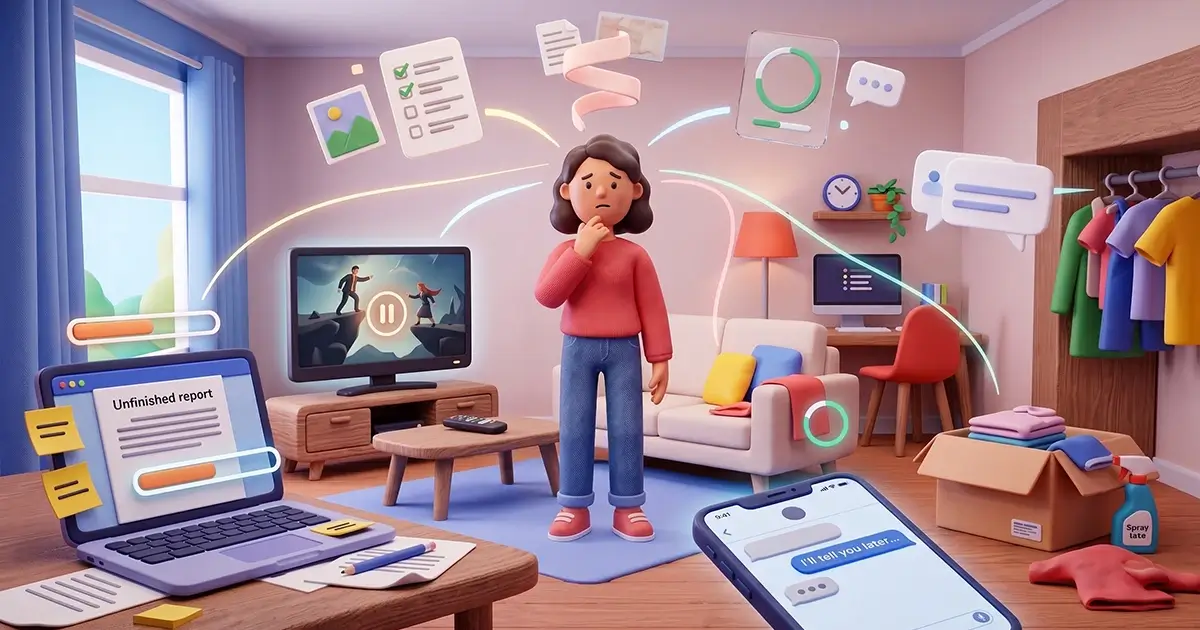
Ever notice how an unfinished task can sit in the back of your mind for hours, while a finished one disappears the moment it's done? That's not just you being forgetful in one direction and sharp in the other. It's a documented psychological pattern called the Zeigarnik Effect, and once you know what to look for, you'll start spotting it everywhere.
In this post, we're skipping the textbook definition and going straight to real, recognizable examples — the kind you've probably experienced this week without knowing there was a name for it.
What Is the Zeigarnik Effect, Quickly?
The Zeigarnik Effect is the tendency to remember interrupted or unfinished tasks better than completed ones. It's named after Soviet psychologist Bluma Zeigarnik, who first noticed the pattern in the 1920s after observing that waiters could recall the details of orders still in progress, but forgot them almost instantly once the bill was paid.
Your brain treats an unfinished task like an open browser tab — it keeps a little bit of processing power running in the background until the task is closed out. It's not a conscious decision. You don't choose to keep thinking about the email you didn't send; your mind just quietly holds onto it as unresolved business.
This is different from simply having a bad memory or a good one. It's selective. The same person who can't remember what they had for lunch yesterday might replay an unfinished argument from three weeks ago in perfect detail. The difference isn't memory strength — it's completion status.
That's the whole mechanism in a nutshell. Now let's look at where it actually shows up in daily life.
Example 1: The Waiter Who Forgets Your Order

This is the example that started it all, so it earns the first spot on this list.
Bluma Zeigarnik's original observation came from watching restaurant waitstaff. A waiter could rattle off a complicated, multi-table order from memory without writing anything down — as long as the order hadn't been paid yet. The second the bill was settled, that same detailed memory vanished almost completely.
Zeigarnik took this observation into the lab and ran controlled experiments where participants worked on puzzles and simple tasks, some of which were interrupted before completion. The result was consistent: people remembered the interrupted tasks significantly better than the ones they'd finished.
The takeaway isn't really about waiters. It's that your brain doesn't file away a task as "done and archived" until it's actually done. Until then, it stays active, a little heavier than it needs to be.
The Original Experiment, In More Detail
Zeigarnik's lab version of this test had participants complete a series of small tasks — things like solving simple puzzles or arithmetic problems. For roughly half the tasks, she interrupted the participant before they could finish. For the other half, she let them complete the task normally.
Afterward, when participants were asked to recall as many tasks as they could, they remembered the interrupted ones at a noticeably higher rate — some estimates from her original work put it at around 90% better recall for unfinished tasks. That gap is what turned a casual restaurant observation into a genuine psychological principle.
It's worth being fair here: modern replication attempts haven't always found an effect this large, and the size of the gap seems to depend a lot on how personally invested someone is in the task. Still, the general direction of the finding — unfinished sticks better than finished — has held up reasonably well for almost a century.
Example 2: TV and Movie Cliffhangers

You already know this one, even if you've never named it.
A show ends its season on an unresolved plot point — a character in danger, a secret about to be revealed, a decision left hanging — and suddenly you're thinking about a fictional problem for weeks. That's not an accident of storytelling. It's the Zeigarnik Effect being used deliberately.
Writers and showrunners understand that an unresolved story stays in your head far longer than a neatly wrapped-up one. A satisfying ending is forgettable in a way a cliffhanger never is.
Clickbait Headlines Work the Same Way
Headlines like "You won't believe what happened next" or "The one thing doctors don't want you to know" are doing a smaller, cheaper version of the same trick. They open a loop in your mind and dangle the resolution just out of reach, which is usually enough to get the click.
Music Does It Too
Ever had a song end mid-phrase, or get cut off before the final note resolves, and felt weirdly unsettled by it? Composers have leaned on this instinct for centuries, even outside of pop culture. An unresolved chord progression creates tension your ear wants closed, and it's part of why certain endings feel deeply satisfying while others feel like something's missing.
Podcasts and audiobooks use a lighter version of the same trick with "next time on" teasers dropped at the very end of an episode, right when your attention is still highest.
Example 3: Abandoned Cart Emails

If you've ever added something to an online shopping cart, gotten distracted, and then received an email an hour later saying "you left something behind," you've been on the receiving end of a very intentional Zeigarnik Effect strategy.
Online retailers know that an incomplete purchase behaves like an incomplete task psychologically. It nags at you slightly, even if you don't consciously notice it. The reminder email isn't just a helpful nudge — it's timed to arrive while that mental "open loop" is still active, before your brain has had the chance to fully let it go.
This same principle shows up in:
- Progress bars that show a profile is "80% complete"
- Subscription apps that track an unfinished onboarding checklist
- Email newsletters that end mid-story with a "read more" link
Each one is quietly exploiting the same discomfort: an unfinished thing pulls at your attention more than a finished one does.
Why This Tactic Is So Effective
What makes the abandoned cart email particularly clever is timing. Marketers don't wait days to send it — most systems trigger it within one to three hours. That's not a coincidence. It's aimed at catching you while the "open loop" from browsing is still fresh, before your brain has had the chance to fully move on and file the whole shopping trip away as a non-event.
The same logic explains why fitness apps show you a "streak" about to break, or why software trials remind you that your free plan setup is "almost done." Each message is really just saying, in different words: you started this, and it's still open.
Example 4: The To-Do List That Won't Leave You Alone

This is probably the most personal version of the effect, and the one most people deal with daily.
You know the feeling: it's 11 PM, you're trying to fall asleep, and your brain decides this is the perfect moment to remind you about the email you didn't send, the appointment you haven't booked, and the report that's still half-finished. None of these tasks are urgent right now. That doesn't matter. They're unfinished, so your brain keeps them on the active list.
This is why a lot of productivity advice — writing a to-do list before bed, doing a "brain dump," or even just starting a task badly rather than not starting it at all — actually works. The moment you write the task down or take the first small step, your brain treats it as partially processed rather than fully open, and the mental noise quiets down.
Some research on this phenomenon has focused specifically on sleep and rumination, finding that unresolved goals can create intrusive thoughts that bleed into completely unrelated tasks — which is part of why it's so hard to concentrate on one thing when three other things are sitting unfinished in the background.
Why Starting Beats Finishing (Sometimes)
Here's the counterintuitive part: you don't need to finish a task to get some relief from the Zeigarnik Effect. Simply starting it, or writing it down with a clear next step, is often enough to lower the mental tension. This is part of why "just write one sentence" is such common advice for beating writer's block — it's not really about the sentence, it's about closing the open loop of "I haven't started."
Why These Examples Matter
Once you notice the pattern in one area of life, it tends to show up everywhere else too. The waiter's memory, the TV cliffhanger, the abandoned cart email, and the 11 PM to-do list panic are all the same underlying mechanism wearing different outfits.
Some of these examples work in your favor — like using an unfinished task to fuel focus. Others are being used on you, often by people who understand this psychology better than you do, like marketers and content creators. Recognizing the pattern is the first step to deciding when to let it run and when to close the loop on purpose.
FAQs
Is the Zeigarnik Effect the same as procrastination?
Not exactly, though they're closely related. The Zeigarnik Effect explains why unfinished tasks feel mentally "loud," while procrastination is what happens when that mental noise leads you to avoid the task instead of starting it. One is the itch, the other is what you do (or don't do) about it.
Does the Zeigarnik Effect apply to everyone equally?
No. Research suggests the strength of the effect varies based on factors like how personally relevant the task feels, how difficult it is, and individual personality differences. Some people experience it much more intensely than others.
Can I use the Zeigarnik Effect to improve my memory or focus?
Yes, in a limited way. Deliberately pausing a task mid-way, or breaking study sessions into intervals with short breaks, can improve recall — this is part of the thinking behind techniques like the Pomodoro Method. The key is pausing with intention, not just leaving everything half-done by accident.
Is this a proven, universally accepted theory?
The core observation has held up reasonably well since 1927, but it's worth noting that later replication studies have shown mixed results, and the effect's strength seems to depend heavily on context. It's a well-supported pattern rather than an ironclad law of memory.
How is this different from the Ovsiankina Effect?
They're related but distinct. The Zeigarnik Effect is about *remembering* unfinished tasks better. The Ovsiankina Effect, studied by Zeigarnik's colleague Maria Ovsiankina, is about the urge to actually *go back and finish* an interrupted task. One is a memory bias, the other is a behavioral pull.
Final Thoughts
The Zeigarnik Effect is a small, almost invisible mental habit that quietly shapes a surprising amount of your day — what you remember, what keeps you up at night, and what makes you click. Now that you can name it, you'll probably start noticing it in places this list didn't even cover.
If you've ever wondered why an unresolved argument replays in your head far more than a resolved one, that's the same effect showing up in your relationships — and that's exactly what we're unpacking next.
Comments (0)
No comments yet. Be the first to share your thoughts!
Leave a comment
Your comment will appear after it's reviewed. Your email is never shown publicly.