
Why We Fall for the Sunk Cost Fallacy (Psychology)
Why do we keep going after a bad decision? Explore loss aversion, escalation of commitment, and the psychology behind the sunk cost fallacy
 Berry Bits
·
October 23, 2026
·
9 min read
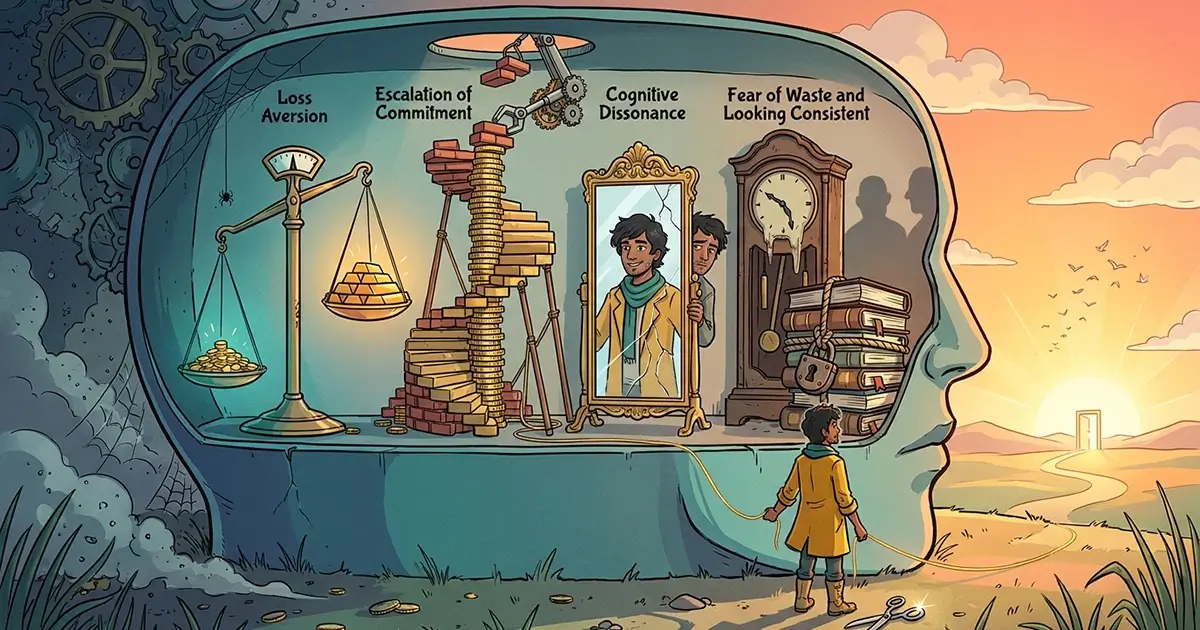
You are halfway through a book you do not enjoy. The story is slow, the characters are flat, and you already know how it will end. Yet you keep reading, because you have already finished 200 pages.
That tiny choice is the sunk cost fallacy at work. It feels harmless in a book, but the same mental habit can keep us stuck in bad investments, unhappy jobs, and struggling marriages for years.
So why do intelligent, capable people fall for it? The answer lies in how the human mind handles loss, effort, and self-image. This article breaks down the psychology of the sunk cost fallacy and walks through four examples that show it in action.
What is the Sunk Cost Fallacy?
A sunk cost is any investment of time, money, or effort that you cannot recover. The fallacy occurs when that past investment drives your next decision.
Logically, it should not. Whether you continue or quit, the cost is already gone. Only future outcomes can still be changed.
Our minds rarely follow that logic. Instead, we ask, “How do I avoid wasting what I have already put in?” That question feels responsible, but it points us toward the past instead of the future.
The Psychology Behind Sunk Cost Bias
Several well-studied mental forces work together here. Understanding them is the first step to loosening their grip.
Loss Aversion: Losses Hurt More Than Gains Feel Good
Psychologists Daniel Kahneman and Amos Tversky showed that people feel the pain of a loss more strongly than the pleasure of an equal gain. Losing 1,000 rupees stings more than finding 1,000 rupees delights.
Quitting makes a loss feel official. As long as you keep going, you can tell yourself the investment might still pay off. Stopping turns that hope into a fact, and our brains will go to great lengths to avoid that moment.
Escalation of Commitment: Doubling Down
In the 1970s, researcher Barry Staw found that people often invest more in a failing course of action, especially when they feel personally responsible for it. This pattern is called escalation of commitment.
Each new investment raises the stakes. Having already spent so much, stopping feels even harder, so we spend more. The cycle feeds itself.
Cognitive Dissonance: Protecting Our Self-Image
Leon Festinger’s theory of cognitive dissonance explains the discomfort we feel when our actions and beliefs clash. If you believe you are a smart decision-maker, but you are stuck in a bad decision, something has to give.
Quitting forces you to admit the mistake. Continuing lets you maintain the story that your earlier choice was wise. Many people choose the story over the facts.
The Fear of Waste and the Need to Look Consistent
Most of us were raised to value effort, loyalty, and finishing what we start. These are good values, but they can be hijacked. “Don’t waste it” becomes a rule that overrides “Is this still worth it?”
Social pressure adds to the pull. Quitting can feel like admitting failure in front of family, colleagues, or friends, so we stay the course to appear consistent.
What the Research Shows
In a classic 1985 study, Hal Arkes and Catherine Blumer asked people to imagine they had bought two ski trips, one for $100 and a better one for $50, and that both were on the same weekend. Many chose the more expensive trip even though they expected to enjoy it less.
Their reason was simple. They had paid more, so they felt they had to use it. The enjoyment they would actually get hardly entered the decision.
Governments and large companies fall into the same trap. The famous Concorde project is often cited because it continued for years after it was clear the costs would far outweigh the returns. Sunk cost bias is not a personal weakness. It is a human one.
Example 1: The Stock That Never Recovers (Loss Aversion)

Kamran bought shares in a company at 100 rupees each. Over the next year, the price fell to 60. The business was losing customers, and analysts were becoming pessimistic.
He kept the shares. “I will sell when it gets back to 100,” he told himself. A year later, it dropped to 40. He still refused to sell.
What Is Happening Psychologically
Kamran is not holding the stock because he believes in its future. He is holding it because selling would turn a paper loss into a real one, and loss aversion makes that feel unbearable.
His buying price has become an anchor. The market does not care what he paid, but he cannot stop thinking about it.
The Better Question
A clearer question would be, “If I had this money in cash today, would I buy this stock?” If the answer is no, then holding it is the same as buying it again.
Example 2: The Project Nobody Wants to Cancel (Escalation of Commitment)

A manager named Farah launches a new software system for her company. It is meant to take six months and cost a modest amount. Eighteen months later, it is still unfinished, and the budget has tripled.
Her team privately doubts it will ever work as intended. But Farah approves more funding, again and again. “We have already spent so much,” she says. “If we stop now, it will all have been for nothing.”
What Is Happening Psychologically
Farah’s reputation is tied to this project. Cancelling it would mean admitting a mistake in front of her bosses, so every extra rupee is spent partly to protect her image.
This is classic escalation of commitment. The more she has invested, the harder it feels to stop, so she invests more.
The Better Question
A healthy team would ask, “If we were starting today, knowing what we know now, would we fund this project?” Some organizations even set review points in advance, so the decision to stop is made calmly instead of in the heat of the moment.
Example 3: Staying Married to Keep Up Appearances (Self-Justification)

Nadia and her husband have been married for fifteen years. For most of that time, they have been more like business partners than a couple. They manage the house, the children, and the finances well, but warmth and honesty disappeared long ago.
When Nadia thinks about whether the marriage can change, she hears familiar thoughts. “Everyone in our family thinks we are the perfect couple.” “I have invested my whole adult life in this.” “What would people say?”
What Is Happening Psychologically
Two forces are at work. Cognitive dissonance makes it painful to admit that years of effort have not led to happiness. Social pressure makes leaving feel like a public failure.
So Nadia stays, not because she believes things will improve, but because staying protects her story and her image.
An Important Balance
This does not mean every difficult marriage should end. Every long marriage faces hard seasons, and many couples grow stronger by working through them honestly, sometimes with the help of a counselor.
The fallacy applies when the only reason to stay is the time already spent or the fear of judgment. If both spouses are willing to rebuild, staying is a choice for the future. If neither is, “we have been together so long” is not a reason by itself.
Example 4: Finishing the Bad Movie (Everyday Sunk Costs)

Not every example is dramatic. Imagine Hamza buys two tickets to a film that has received poor reviews. Twenty minutes in, it is clear that it is dull and confusing.
He and his friend look at each other, both thinking of leaving. “But we paid for the tickets,” Hamza whispers. They sit through two more hours.
What Is Happening Psychologically
Hamza is practicing a form of mental accounting. He has opened a mental account labeled “movie,” and he feels he must get value from it.
But the money is gone either way. The only thing left to decide is how to spend the next two hours. Staying costs him more than the ticket price because it also costs his time.
Why Small Examples Matter
Practicing on small decisions builds the habit of asking, “What do I want from here?” That habit becomes valuable when the stakes are higher.
How to Break Free from the Sunk Cost Fallacy
You cannot switch off these mental forces, but you can learn to notice them. A few habits make a real difference.
Use the Fresh-Start Test
Ask yourself, “If I had no history with this, would I choose it today?” If the answer is no, you have your answer.
Separate the Past from the Future
Write down what you have already spent, then set it aside. Compare only the costs and benefits that still lie ahead.
Listen for Warning Phrases
Statements like “I have come too far,” “I cannot waste this,” or “After everything I have put in” are signs that the past is steering your choice.
Decide Exit Points in Advance
Set clear conditions for stopping before you begin, such as a loss limit or a deadline. Rules made calmly beat decisions made emotionally.
Ask Someone Outside the Situation
A trusted friend or mentor has no emotional investment in your past choices and can see your options more clearly.
Frequently Asked Questions
1. Why do we fall for the sunk cost fallacy?
It comes from several mental tendencies working together: loss aversion, the desire to avoid admitting mistakes, cognitive dissonance, and the wish to appear consistent. Together, they make quitting feel more painful than continuing.
2. What is the link between loss aversion and sunk costs?
Loss aversion means we feel losses more strongly than equal gains. Quitting makes a loss real, so we keep going to postpone that feeling, even when continuing makes the loss bigger.
3. What is escalation of commitment?
It is the tendency to invest more in a failing decision because of what has already been invested. Each extra investment makes stopping feel harder, so the cycle continues.
4. Is persistence always a sunk cost trap?
No. Persistence is healthy when it is based on a realistic belief that things can improve. It becomes the fallacy when the main reason to continue is protecting past investment.
5. Can people become immune to sunk cost bias?
Probably not completely, because it is a natural human tendency. But awareness, pre-set decision rules, and honest outside feedback can greatly reduce its influence.
Final Thoughts
The sunk cost fallacy is not a sign of weakness or poor intelligence. It is the result of a mind trying to avoid pain, protect its self-image, and honor effort.
But the past cannot be changed, and no amount of extra investment will bring it back. What you can change is the next decision.
Next time you feel stuck because of how much you have already put in, pause and ask one question: “Knowing what I know now, what is the best use of my time, money, and energy from here?” Your answer may surprise you, and it may free you.
Have you ever stuck with something longer than you should have because of what you had already invested? Share your story or thoughts in the comments below. We would love to hear from you!

Comments (0)
No comments yet. Be the first to share your thoughts!
Leave a comment
Your comment will appear after it's reviewed. Your email is never shown publicly.