
Why You Keep Double Checking Everything: Understanding Checking OCD
Learn why checking OCD causes repeated checking of locks, appliances, messages, and other daily tasks. Discover symptoms, causes, examples, and practical ways to manage checking compulsions.
 Berry Bits
·
June 24, 2026
·
6 min read
Berry Bits
·
June 24, 2026
·
6 min read
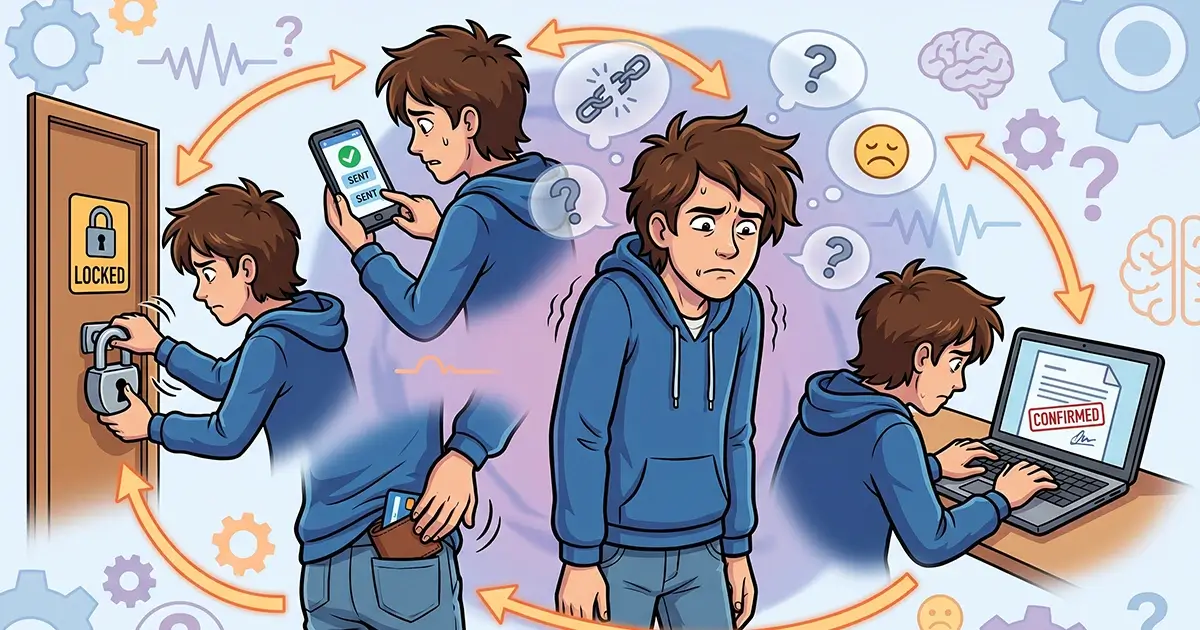
Have you ever locked your door, walked away, and then suddenly wondered if you actually locked it? Maybe you've turned around to check again, only to find that it was locked exactly as you remembered.
For many people, occasional checking is normal. However, when checking becomes repetitive, distressing, and difficult to control, it may be a sign of Checking OCD.
Checking OCD is a common subtype of Obsessive-Compulsive Disorder (OCD). It involves persistent doubts and fears that lead a person to repeatedly verify things, even when they already know the task was completed correctly.
The difficult part is that each check provides temporary relief, but the relief doesn't last long. Soon, doubt returns, creating a cycle that can consume significant time and mental energy.
What Is Checking OCD?
Checking OCD is characterized by intrusive thoughts and uncertainty about whether something important has been done correctly.
A person may worry that they forgot to complete a task, made a mistake, or caused potential harm. To reduce this anxiety, they perform checking behaviors.
Common checking behaviors include:
- Rechecking locks and doors
- Verifying appliances are turned off
- Reviewing emails repeatedly before sending
- Confirming appointments multiple times
- Looking for mistakes in completed work
- Repeatedly checking personal belongings
The goal of checking is usually to gain certainty. Unfortunately, OCD often makes certainty feel impossible.
Why Does the Brain Keep Doubting?
Most people trust their memory after completing a task. With Checking OCD, that trust becomes weakened.
Instead of accepting, "I locked the door," the mind generates questions such as:
- What if I only thought I locked it?
- What if I got distracted?
- What if I made a mistake?
- What if something bad happens because I missed something?
The more attention someone gives to these doubts, the stronger they become.
Ironically, repeated checking can make memory confidence worse. When a task is checked many times, each repetition starts blending together, making it harder to remember the original action clearly.
The Cycle of Checking OCD
Understanding the cycle helps explain why the behavior is so difficult to stop.
Step 1: An Intrusive Thought Appears
A doubt enters the mind.
"What if the stove is still on?"
Step 2: Anxiety Increases
The person imagines negative consequences.
"What if it starts a fire?"
Step 3: Checking Behavior Occurs
The person checks the stove.
Step 4: Temporary Relief
Anxiety decreases for a short time.
Step 5: Doubt Returns
Soon another thought appears.
"Did I really check properly?"
The cycle then repeats.
Over time, checking becomes a habit that the brain uses whenever uncertainty appears.
Example 1: Repeatedly Checking Work Documents

Imagine a professional preparing an important report for a client.
Before submitting it, they review the document once. Then they review it again. Then a third time. After sending it, they reopen the file to search for mistakes they may have missed.
Even after finding nothing wrong, they continue worrying about possible errors.
The issue is not the report itself. The issue is the inability to feel certain that everything is correct.
This can significantly reduce productivity and increase stress in workplaces.
Example 2: Constantly Verifying Personal Belongings

A person leaves a restaurant and suddenly wonders whether they still have their wallet.
They check their pocket and confirm it is there.
A few minutes later, they check again.
Then again before entering their car.
Even though the wallet never left their possession, the feeling of uncertainty keeps returning.
Checking temporarily reduces anxiety but strengthens the habit over time.
Example 3: Rechecking Messages and Emails

Many people review messages before sending them.
With Checking OCD, this behavior can become excessive.
Someone may spend twenty minutes reviewing a simple email. They repeatedly scan for spelling mistakes, missing attachments, incorrect wording, or potential misunderstandings.
After sending the message, they may reopen their sent folder several times to make sure everything was sent correctly.
The fear is often linked to making mistakes, embarrassment, criticism, or causing problems for others.
Example 4: Locking the Door and Checking Again

One of the most recognized examples involves locking doors.
A person locks their front door before leaving home. A few steps later, doubt appears.
"Did I actually lock it?"
They return and verify the lock.
As they walk away again, another thought appears.
"What if I only checked the handle and not the lock?"
They go back once more.
Even after multiple confirmations, certainty remains elusive because the problem isn't the lock. The problem is the OCD-driven need for absolute certainty.
This example is often the first sign people notice when checking behaviors begin interfering with daily life.
How Checking OCD Affects Daily Life
Checking OCD can impact far more than a person's schedule.
Increased Stress
Constant doubt creates ongoing mental tension and anxiety.
Time Consumption
Simple tasks can take much longer than necessary because of repeated verification.
Reduced Confidence
People may stop trusting their memory, judgment, and decision-making abilities.
Relationship Difficulties
Family members and friends may struggle to understand why repeated checking continues despite reassurance.
Lower Productivity
Work, school, and personal responsibilities can suffer when excessive checking consumes attention and energy.
Why Reassurance Doesn't Fully Help
Many people seek reassurance from others.
They may ask questions like:
- Are you sure I locked the door?
- Did you see me turn off the stove?
- Does this email look okay?
While reassurance may help temporarily, it often reinforces the OCD cycle.
The brain learns that uncertainty must always be resolved immediately instead of tolerated.
As a result, reassurance can become another form of checking behavior.
Healthy Ways to Manage Checking OCD
Managing Checking OCD often involves learning to tolerate uncertainty rather than eliminating it completely.
Recognize the Pattern
Awareness is the first step. Notice when checking is driven by anxiety rather than genuine necessity.
Limit Repeated Checks
Set a reasonable checking limit. For example, lock the door once and consciously acknowledge the action.
Practice Accepting Uncertainty
Absolute certainty rarely exists in everyday life. Learning to accept small amounts of uncertainty can reduce compulsive behaviors.
Strengthen Memory Through Attention
When completing a task, focus fully on the action. Being present can improve confidence in your memory later.
Seek Professional Support
Mental health professionals often use evidence-based approaches such as Cognitive Behavioral Therapy (CBT) and Exposure and Response Prevention (ERP) to help individuals manage OCD symptoms effectively.
Frequently Asked Questions (FAQs)
Is checking things multiple times always OCD?
No. Occasional checking is normal. It becomes a concern when it causes significant anxiety, consumes time, interferes with daily life, or feels difficult to control.
Why doesn't checking make me feel better permanently?
Checking usually provides temporary relief. However, it teaches the brain that checking is necessary for safety, which strengthens the cycle over time.
Can Checking OCD affect digital activities?
Yes. Many people repeatedly check emails, messages, online forms, passwords, and social media posts.
Is Checking OCD related to anxiety?
Yes. Anxiety is a major component of Checking OCD. The checking behavior is often an attempt to reduce anxiety caused by uncertainty.
Can Checking OCD be treated?
Yes. Many people experience significant improvement through therapies such as CBT and ERP, often with guidance from trained mental health professionals.
Conclusion
Checking OCD is more than simply being careful. It involves a persistent cycle of doubt, anxiety, and repeated verification that can interfere with daily life.
Whether someone is checking work documents, personal belongings, emails, or locked doors, the underlying issue is often the same: difficulty tolerating uncertainty.
Understanding how the cycle works is an important first step toward breaking it. By recognizing the pattern and developing healthier responses to doubt, individuals can gradually reduce compulsive checking and regain confidence in their decisions, memories, and daily routines.




Comments (0)
No comments yet. Be the first to share your thoughts!
Leave a comment
Your comment will appear after it's reviewed. Your email is never shown publicly.