
Sunk Cost Fallacy Examples: 4 Real-Life Situations
See sunk cost fallacy examples in relationships, jobs, money, and shopping, and learn how to spot when you’re throwing good effort after bad
 Berry Bits
·
October 23, 2026
·
10 min read
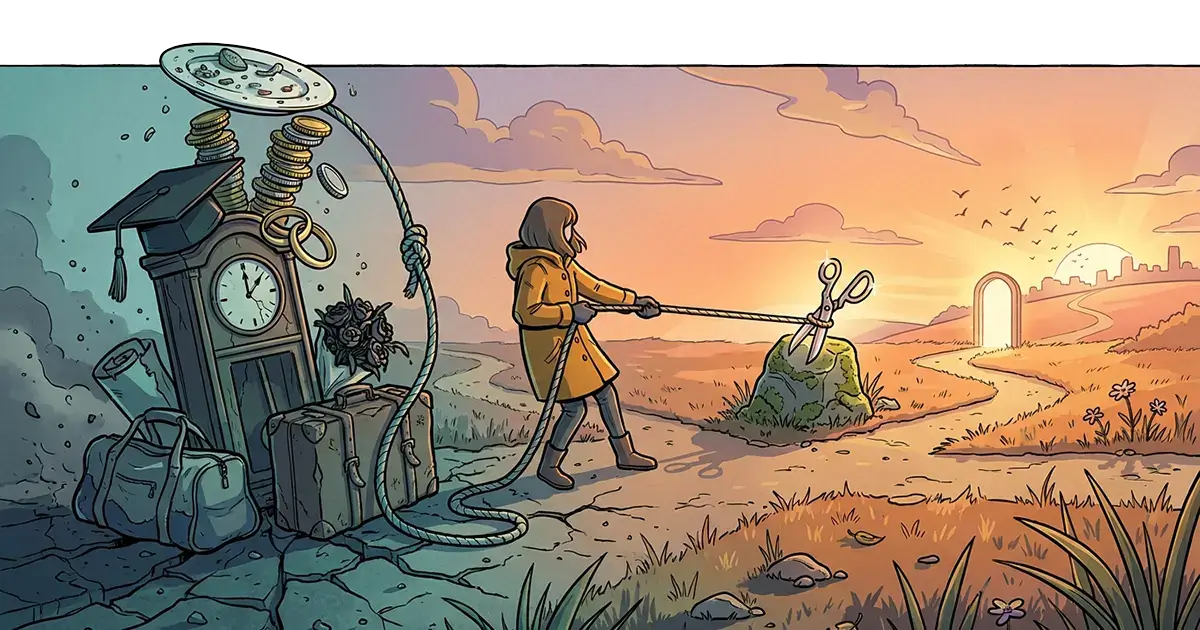
You have probably sat through a terrible movie because you had already paid for the ticket. Or finished a meal you did not enjoy because it was expensive. Moments like these seem harmless, but the same mental pattern shows up in far bigger decisions: marriages, careers, savings, and everyday purchases. Psychologists call it the sunk cost fallacy, and it quietly shapes more of our lives than most of us realize.
In this article, we will walk through four sunk cost fallacy examples drawn from real life, so you can recognize the pattern when it appears in your own choices. Understanding sunk costs will not make every decision easy, but it can help you stop letting yesterday’s investment hold tomorrow hostage.
What is the Sunk Cost Fallacy?
A sunk cost is anything you have already spent that you cannot get back. It might be money, time, energy, or emotional effort. The fallacy happens when that past investment influences your decision about what to do next, even though it should not.
Here is the logic problem. The past is fixed. Whether you continue or quit, the cost is already gone. The only thing you can still change is the future. A rational decision would compare what lies ahead under each option. Instead, our brains ask a different question: “How can I justify everything I have already put in?”
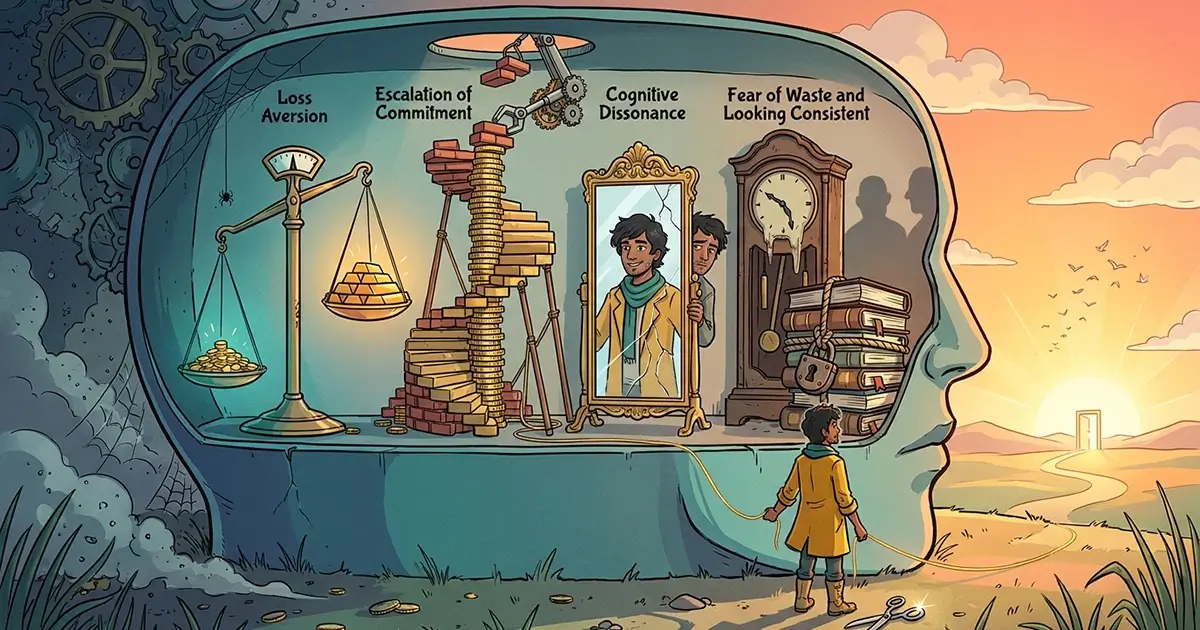
This happens for a few reasons. We dislike admitting a mistake, because quitting feels like proof that we wasted resources. We also hate loss, and psychologists have shown that losses feel roughly twice as painful as equivalent gains feel good. Add a desire to appear consistent, and you get a powerful urge to keep going, even when going on makes things worse.
Now let us look at how this plays out in real situations.
Example 1: Staying in a Marriage Out of Habit

Sunk cost in relationships is one of the most emotionally loaded versions of this bias, and it deserves a careful look.
Imagine a woman named Hira who has been married for twelve years. Somewhere along the way, she and her husband stopped communicating. They share a home, a routine, and two children, but the warmth and respect have faded. They have tried counseling twice, and nothing has changed. Hira privately admits she feels lonely inside her own marriage.
Yet when she thinks about making a change, her mind returns to the same arguments. “We have been through so much together.” “I have given him the best years of my life.” “What was all of that for if I walk away now?”
Notice what is happening. Those twelve years are real, and they matter. But they are not a reason to stay. They are simply a fact of the past. The useful question is not “How much have I already invested?” but “What do the next ten years look like if nothing changes, and what would it take to make them better?”
It is important to be careful here. The sunk cost fallacy does not mean you should abandon a marriage the moment it gets difficult. Every long marriage goes through hard seasons, and many couples come out stronger after working through them. The fallacy applies when the main reason for staying is the time already spent, rather than a realistic belief that things can improve or a genuine desire to rebuild.
A healthier approach is to ask what has changed, what both spouses are willing to do, and whether the effort is being returned. If the answer is yes, staying is a choice made for the future. If the answer is no, “we have been together so long” is not enough on its own.
Example 2: Holding On to the Wrong Career

Our second real life sunk cost example comes from the workplace, where it is surprisingly common.
Consider Bilal, who spent four years and a large amount of family savings on a degree in a field he now realizes he dislikes. After graduating, he took a job in that field and has been there for six years. He is not growing, he dreads Monday mornings, and he is quietly curious about a completely different path, like design or teaching.
Every time he considers a switch, his thoughts spiral. “I spent four years studying this.” “My family sacrificed so much for my education.” “Starting over at thirty-three would be crazy.”
Each of those statements points backward. The degree is already earned. The tuition is already paid. The six years are already lived. None of these things disappear if Bilal changes direction, because the skills, discipline, and experience he gained come with him. What he loses by staying is something he cannot recover: the next twenty years of his working life.
Here is a useful test. Suppose someone offered Bilal his current job today, with no history attached. Would he accept it? If the honest answer is no, then the only thing holding him in place is the sunk cost.
This does not mean he should quit tomorrow with no plan. A smart transition might involve learning new skills at night, freelancing on the side, or testing the new field before leaping. The point is that his decision should be based on future happiness and opportunity, not on defending a choice he made years ago.
Example 3: Throwing Good Money After Bad

Money is where sunk costs are easiest to measure, and where they can do the most visible damage.
Think about Usman, who invested 500,000 rupees in a small business with a friend. Within a year, it was clearly struggling. Sales were low and expenses were high. Still, he put in another 200,000 to “give it a fair chance.” Then another 150,000 when a supplier demanded payment. Each time he told himself, “I cannot stop now, or everything I have put in will be lost.”
This is a classic escalation of commitment. Every extra payment makes the previous ones feel more important to protect, so he keeps feeding money into something that is not working. The original 500,000 was gone the moment the business began to fail. The new money is a separate decision, and it deserves its own honest evaluation.
The same thing happens in other areas of finance. People hold losing stocks for years, waiting to “break even” before selling. Others keep repairing an old car that costs more to fix every month because they already paid so much for the last repair. In each case, the real question should be: “If I had this money in my hand today, would I put it into this?”
If the answer is no, continuing is not loyalty to your earlier self. It is just a larger loss.
Cutting losses is uncomfortable, but it is one of the most valuable financial habits you can build. Professionals often set exit rules in advance, such as “If this investment drops by twenty percent, I will sell,” precisely because they know emotion will cloud their judgment later.
Example 4: Shopping and Everyday Purchases

Not every sunk cost fallacy example involves life-changing stakes. Some are small, and noticing them can train you to catch the bigger ones.
Picture Sana, who bought an expensive gym membership in January. By March, she has visited only twice and dreads going. Still, she forces herself to attend on days when she is exhausted, sick, or simply miserable, telling herself, “I paid for this, so I have to use it.”
Or consider a different scenario. You order a large meal at a restaurant, get full halfway through, and keep eating because you do not want to “waste” the food. The food is already paid for either way. Finishing it does not bring the money back. It only adds discomfort to the loss.
Shopping gives us plenty of similar cases:
- Keeping clothes with the tags still on because they were pricey, even though you never wear them
- Continuing a streaming subscription you do not watch because you have been subscribed “for years”
- Sitting through a boring event because the tickets were expensive
- Finishing a mediocre book or series because you are already halfway through
The cost is gone in every one of these situations. What remains is a choice about how to spend your time and energy from here. Giving away the unused clothes, canceling the subscription, or walking out of the event might feel wasteful, but staying often wastes something more valuable: your attention.
How to Spot and Overcome the Sunk Cost Fallacy
Recognizing sunk costs in the moment takes practice, but a few simple habits can help.
Ask the fresh-start question. Imagine you were facing this decision for the first time, with no past investment. What would you choose? That answer is usually the most honest one.
Separate past from future. Write down what you have already spent, then cross it out. Focus only on the costs and benefits that still lie ahead.
Watch your language. Phrases like “I have come too far to quit,” “I cannot waste this,” or “After everything I put in” are strong warning signs.
Set decision points in advance. Decide early what results would make you stop, before emotions get involved.
Talk to someone outside the situation. A trusted friend or mentor does not feel the same attachment to your past choices, so they can see the decision more clearly.
Reframe quitting. Walking away from something that is not working is not failure. It is a sign that you are learning and adjusting.
Frequently Asked Questions
1. Is the sunk cost fallacy always bad?
Not always. Past investments can sometimes carry useful information, such as how much progress you have made toward a goal. The problem arises when the past cost itself becomes the main reason to continue, rather than the realistic outlook for the future.
2. What is the difference between perseverance and the sunk cost fallacy?
Perseverance looks forward. You keep going because you believe the effort will lead somewhere worthwhile. The sunk cost fallacy looks backward. You keep going because you do not want to admit that earlier effort was in vain. A good test is whether you would start this thing again today.
3. Why is the sunk cost fallacy so common in relationships?
Marriages involve years of shared memories, family, finances, and emotional effort, so the sense of “having already invested too much” is especially strong. Fear of change and social pressure add to it. That is why it helps to look at the quality of the future together, not just the length of the past.
4. How can I tell if I am falling for sunk costs right now?
Notice whether your reasons for continuing are mostly about what you have already spent. If you catch yourself saying “I cannot stop now because of everything I have put in,” you are probably under its influence.
5. Can anyone avoid the sunk cost fallacy completely?
Probably not, since it is a natural human tendency. But awareness makes a big difference. The more often you pause and ask what you would do if you were starting fresh, the weaker its pull becomes.
Final Thoughts
The sunk cost fallacy is tricky because it disguises itself as loyalty, commitment, or responsibility. Whether it shows up in a marriage, a career, a bank account, or a shopping bag, the pattern is the same: we let what is gone steer what comes next.
You cannot get back the time, money, or energy you have already spent. But you can decide how to spend what remains. Honoring your past does not mean being trapped by it. Sometimes the wisest and bravest choice is to accept the loss, learn from it, and move in a better direction.
Have you ever caught yourself falling for the sunk cost fallacy? Share your story or thoughts in the comments below. We would love to hear your experience!

Comments (0)
No comments yet. Be the first to share your thoughts!
Leave a comment
Your comment will appear after it's reviewed. Your email is never shown publicly.