
Pareidolia Effect: Why Your Brain Sees Faces Everywhere
Discover the Pareidolia effect, the psychological reason your brain sees faces in cars, outlets, clouds, and shadows, with real examples and FAQs.
 Berry Bits
·
July 4, 2026
·
6 min read
Berry Bits
·
July 4, 2026
·
6 min read
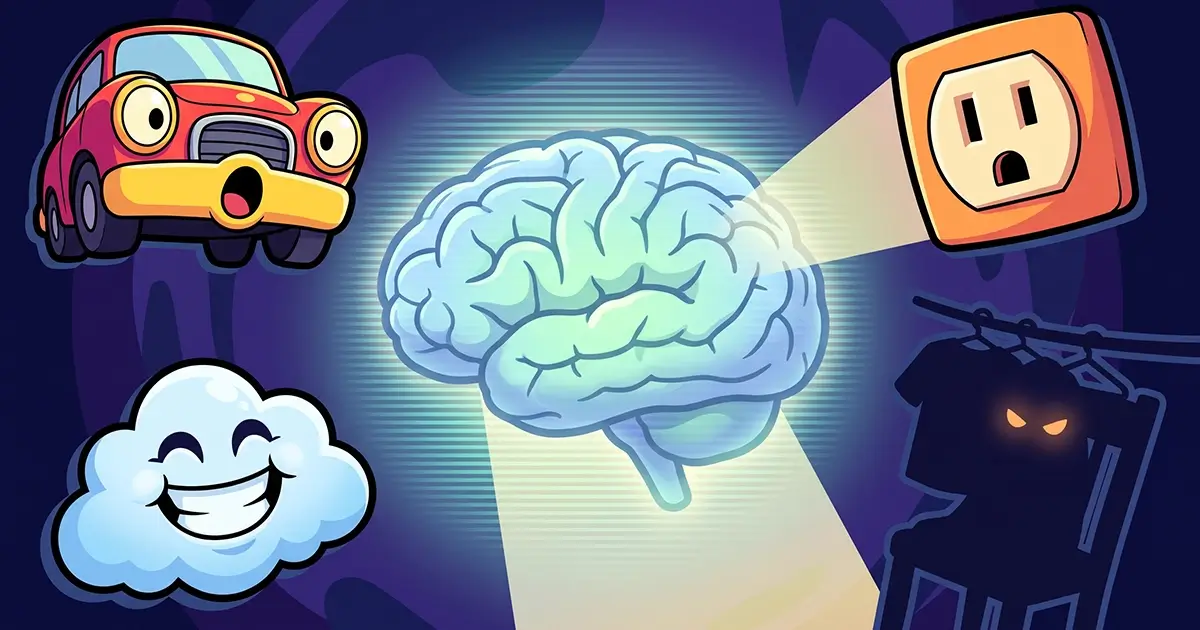
Have you ever glanced at an electrical socket, a car, or a cloud and sworn it was looking back at you? You are not imagining things, and you are definitely not alone. This experience has a name: the Pareidolia effect. It is a well documented psychological phenomenon where the brain perceives familiar patterns, especially faces, in random or unrelated objects. Instead of being a glitch, it is actually a sign of how efficiently your brain works.
What Exactly Is Pareidolia
Pareidolia comes from the Greek words for "beside" and "image," and it describes the brain's tendency to impose meaningful patterns on random stimuli. Your visual cortex is constantly scanning your surroundings, and one of its top priorities is detecting faces. This skill developed over thousands of years because recognizing a face quickly, whether friend or foe, was once a matter of survival. Because of this deep wiring, even two dots and a line can trigger the same neural response as an actual human face.
Why Does the Brain Do This
The fusiform face area, a specific region in your brain, is dedicated almost entirely to facial recognition. It is extremely sensitive and works faster than your conscious thinking. This means it often reacts before you even realize what you are looking at. Scientists believe this over sensitivity is intentional. It is far safer for your brain to mistakenly see a face in a bush than to miss a real threat hiding nearby. In short, your brain prefers false alarms over missed dangers, and pareidolia is a side effect of that protective system.
Example 1: Faces In Car Fronts

One of the most common places people notice pareidolia is in the front of a car. The headlights often resemble eyes, the grille looks like a nose or mouth, and the bumper completes the illusion of a face. Some cars even appear to be smiling, angry, or surprised, depending on their design. Car manufacturers are aware of this effect and sometimes intentionally shape headlights and grilles to evoke a specific emotional impression. This is a clear example of how pareidolia is not just accidental but is sometimes used strategically in design and marketing.
Example 2: Faces In Electrical Outlets

Almost every household has experienced this one. A simple wall socket with two vertical slots and a grounding hole can instantly resemble a shocked or surprised human face. This example is popular because outlets are found almost everywhere, making the effect easy to notice repeatedly. The two slots act as eyes, while the grounding hole below forms an open mouth. Once you notice it in one outlet, you often start noticing it in every outlet you see afterward, which shows how quickly the brain locks onto this pattern.
Example 3: Faces In Clouds

Clouds have fascinated humans for centuries, partly because of pareidolia. Their constantly shifting shapes make it easy for the brain to briefly recognize a face, an animal, or even a familiar object. This is why cloud watching feels like an imaginative and almost dreamlike activity. Unlike fixed objects like cars or outlets, clouds are especially interesting because the "face" you see often disappears within seconds. This temporary quality highlights just how quickly the brain forms these patterns.
Example 4: Faces In Shadows

This is the example most people describe as unsettling. At night, a shadow cast by clothes hanging on a chair, a coat rack, or a random object can suddenly appear to have eyes or a facial structure staring directly at you. This happens because low lighting reduces detail, forcing your brain to fill in the gaps using assumptions. In dim conditions, your visual system leans even more heavily on prediction rather than actual data, making it far more likely to construct a face out of vague shapes. This is exactly the kind of moment described in the original short video, where a shadow, a car, or a pile of clothes suddenly feels like it is staring back at you.
Why This Matters For Understanding Human Psychology
Pareidolia is more than just a fun visual trick. It reveals how the brain prioritizes speed over accuracy when it comes to potential threats or social signals. This same mechanism is linked to how newborn babies recognize their parents' faces almost immediately after birth. It also explains why humans instinctively notice faces in random patterns like wood grain, rock formations, or even food items. Understanding pareidolia gives insight into how evolution shaped the human brain to prioritize connection and safety above precision.
How To Reduce Or Enjoy The Effect
If pareidolia feels unsettling to you, especially in dark environments, try turning on more light or observing the object from a different angle. This often breaks the illusion because your brain receives clearer visual information. On the other hand, many people enjoy pareidolia as a fun mental exercise. Cloud watching, spotting faces in architecture, or noticing patterns in nature can be a lighthearted way to appreciate how your brain works.
Frequently Asked Questions
Is pareidolia a sign of a mental health issue?
No. Pareidolia is a completely normal psychological phenomenon experienced by nearly everyone. It is not linked to any mental health disorder and does not indicate anything unusual about your brain function.
Why do I see faces more often at night?
Low lighting reduces visual detail, so your brain relies more on assumptions to fill in missing information. This increases the chances of misinterpreting shadows or shapes as faces.
Do animals experience pareidolia too?
Some research suggests certain animals, particularly primates, show similar face detection tendencies, although it is most extensively studied in humans.
Can pareidolia be trained or reduced?
While you cannot completely eliminate the effect, increasing lighting, changing your viewing angle, or examining the object closely often reduces the illusion.
Is pareidolia related to creativity?
Yes. Because pareidolia relies on pattern recognition and imagination, individuals with strong creative thinking abilities often notice this effect more frequently.
Final Thoughts
The Pareidolia effect is a fascinating reminder of how powerful and protective the human brain truly is. Whether it is a car front that looks like it is smiling, an outlet that appears startled, a cloud shaped like an animal, or a shadow that seems to be watching you in the dark, all of these moments trace back to the same evolutionary survival mechanism. Instead of feeling unsettled the next time this happens, you can appreciate it as proof of just how remarkably efficient your brain is at protecting you.

Comments (0)
No comments yet. Be the first to share your thoughts!
Leave a comment
Your comment will appear after it's reviewed. Your email is never shown publicly.