
Cognitive Tunneling: Why You Might Seem "Boring" and How to Break the Cycle
Ever feel "boring" because you focus on logic over social flow? Discover how cognitive tunneling impacts your relationships and how to regain your balance.
 Berry Bits
·
June 29, 2026
·
8 min read
Berry Bits
·
June 29, 2026
·
8 min read
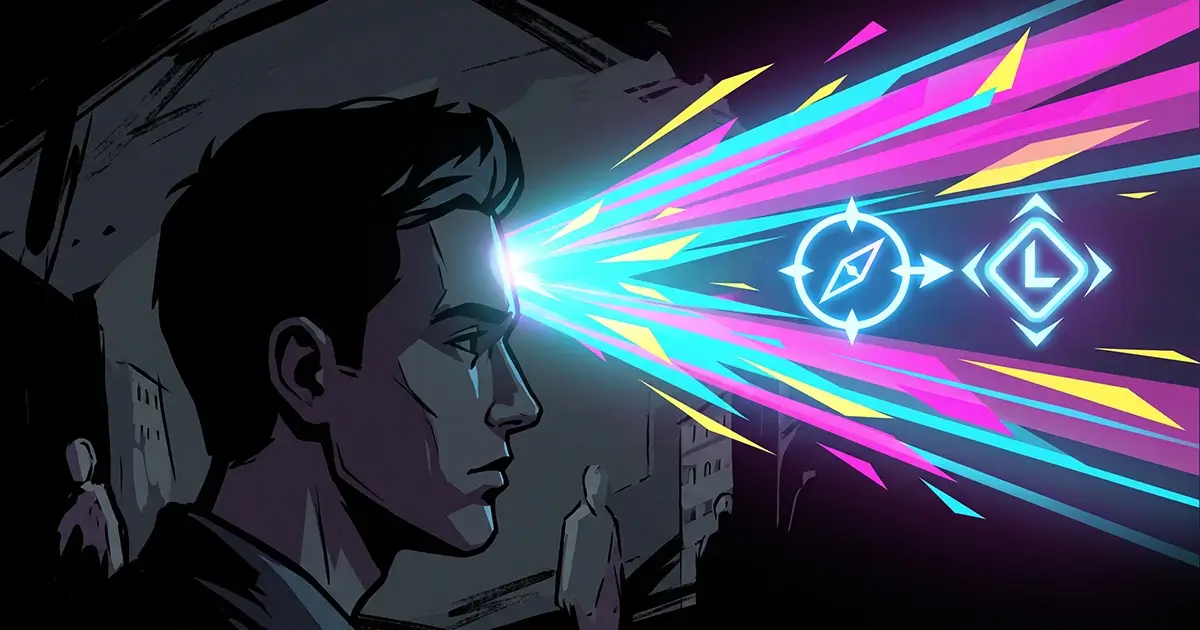
Have you ever walked away from a conversation feeling like you just didn’t "click" with the other person? Perhaps you were trying to be helpful by offering a logical solution to their venting session, or maybe you spent the entire time fact-checking details instead of laughing at the joke. You might have walked away feeling like you were being "boring" or socially inept. In reality, you likely weren't being boring at all—you were experiencing a phenomenon called cognitive tunneling. This article dives deep into why this happens, how it affects your social life, and how you can reclaim your social flow.
Understanding the Anatomy of Cognitive Tunneling
At its core, cognitive tunneling is a psychological state where the brain fixates on a single, narrowly defined category of information while filtering out secondary, often socially relevant cues. Think of your brain’s attention like a spotlight. In a relaxed, social state, that spotlight acts like a floodlight, illuminating a broad area and allowing you to pick up on social nuances, humor, body language, and emotional subtext. When your brain perceives a goal—like solving a problem or being "efficient"—that spotlight tightens into a narrow beam, leaving the rest of your world in the dark.
This isn't a personality flaw, a deficit, or a lack of social intelligence. It is a biological survival strategy. Your brain is wired to prioritize high-priority, logical thinking when it believes it has a "problem" to solve. Throughout human history, this trait allowed our ancestors to focus intently on tracking prey or constructing shelter. Unfortunately, when you’re hanging out with friends, your brain might misidentify a casual social interaction as a task that requires "optimal" performance, causing you to accidentally shut down your ability to engage in the "messy" but essential aspects of human connection.
Why the Brain Prefers "The Tunnel"
To understand why this happens, we must look at cognitive load. The brain is an energy-intensive organ. When it perceives a complex environment, it looks for ways to conserve energy and increase efficiency. "Tunneling" is the brain’s way of reducing the number of variables it has to process. By ignoring "irrelevant" data—like the emotional state of a conversation partner or the lighthearted tone of a gathering—the brain can dedicate all its processing power to the specific logical target it has identified.
When you are deep in this mode, you aren't trying to be difficult or dismissive. You are simply operating under a "task-oriented" framework. Your brain has essentially prioritized the "what" over the "who." While this is a superpower in coding, engineering, or crisis management, it acts as a barrier to empathy in social settings. Recognizing this switch is the first step toward regaining your social fluency and stop feeling like you are "boring" those around you.
Example 1: The Workplace "Tunnel"

Consider an office scenario where a colleague approaches you with a minor error in a shared project document. Your "tunneling" brain immediately switches into efficiency mode. Instead of engaging in the social ritual of small talk or acknowledging their stress, you immediately start firing off instructions on how to fix the spreadsheet. You might even pull up the file and start typing over them without asking. By focusing entirely on the "task" (the error), you have completely ignored the "human" (the colleague who just wanted a bit of validation or collaborative support). Your colleague leaves the interaction feeling dismissed, and you are left wondering why they seem annoyed when you just "saved the day."
Example 2: The "Fix-It" Trap in Relationships

Relationships are fertile ground for cognitive tunneling, especially when a partner is venting. When a friend or partner talks about a difficult day, they are often seeking emotional connection, not a manual for their life. However, if your brain interprets their complaints as a series of issues to be solved, you might start offering unsolicited advice, breaking down the pros and cons of their situation, or even fact-checking their version of events. You are operating from a place of "helping," but your partner feels like you aren't listening. You are trapped in the "solution" tunnel, unable to see that the goal of the conversation is empathy, not optimization.
Example 3: The "Fact-Checking" Impulse

Have you ever been in a group conversation where someone tells a funny anecdote, and instead of reacting to the humor, you feel a compulsion to correct a minor, irrelevant detail? For instance, someone says, "It was at least 100 degrees out yesterday!" and your brain immediately pipes up with, "Actually, the weather report said it peaked at 94 degrees." That sudden, urgent need to ensure accuracy is a classic sign of cognitive tunneling. Your brain has prioritized "truth" and "data" over "social connection." By correcting them, you effectively halt the flow of the conversation, signaling that your need to be accurate is more important than their need to be heard.
Example 4: The "Social Flow" Barrier

This brings us to the scenario we explored in our video. Sometimes, you are simply in a high-priority, goal-oriented headspace. You are focused on efficiency, logic, and output. When a social cue arises—a casual joke, a subtle change in tone, or an invitation to be vulnerable—your brain filters it out because it doesn't align with your current "to-do list." To others, this looks like you are distracted or disinterested. They don't see the internal fire you are putting out; they only see you looking past them, fact-checking their stories, or steering the conversation toward "practical outcomes." Recognizing this is the first step toward regaining your social flow.
The Cost of Efficiency in Social Settings
When we stay in the tunnel too long, we pay a social price. Because our brain is ignoring the subtle cues of others, we often miss opportunities for connection. The people around us start to label us as "robotic" or "distant." It is important to remember that most people value being understood over being corrected. When you spend your energy tunneling, you lose the ability to validate others, which is the cornerstone of human relationship-building. The irony is that by trying to be "smart" or "efficient," you are actually making yourself less effective at building the professional and personal networks that make life and work easier.
How to Break Out of the Tunnel
You can train your brain to recognize the signs of tunneling. Start by practicing "mindful awareness" during conversations. If you feel that urge to correct someone or "solve" their problems, take a two-second pause. Ask yourself: "Is this a task that needs an objective solution, or is this a human moment that needs an emotional connection?" If it is a human moment, consciously choose to lower your "data-processing" shield. Mirror the other person's energy, listen for the feelings behind their words, and resist the urge to provide immediate output. Over time, this becomes a habit, and you will find that you can switch between "tunnel" and "floodlight" modes with ease.
FAQs: Mastering Your Social Focus
Is cognitive tunneling a sign of a mental health condition?
Not necessarily. While it can be associated with certain conditions or high-stress states, it is a normal human cognitive function. Everyone experiences it; some just experience it more frequently due to personality, work habits, or high-pressure environments.
How can I stop tunneling during a conversation?
The best way is to set "priority anchors." Before you enter a social setting, remind yourself that the goal is connection, not completion. If you find yourself offering a solution, pause and ask, "Are you looking for advice or just needing to vent?" This simple question shifts the power back to the other person.
Can cognitive tunneling be beneficial?
Yes. In high-risk fields like surgery, air traffic control, or coding, this kind of focus is essential for accuracy and safety. The problem only arises when you apply this "emergency" focus to "leisure" or "intimate" activities where the primary goal is human connection rather than data output.
Does this make me a "boring" person?
Absolutely not. Being "boring" is a subjective judgment. Most people who experience cognitive tunneling are actually highly intelligent and capable; they are simply "over-functioning" in environments that require "under-functioning" or, more accurately, "relaxing." You are likely just a person with a high drive for efficiency who hasn't yet learned how to turn that drive "off" when it’s time to socialize.
How do I tell if I'm currently in a tunnel?
Notice your physical sensations. Are your shoulders tight? Is your breathing shallow? Are you feeling "urgent" about finishing the conversation? If you feel like you are on a clock or you are mentally listing the next steps in your project while someone is talking to you, you are likely in a tunnel. Consciously relax your posture and deepen your breath to signal to your brain that it is safe to shift out of "tunnel" mode.
Conclusion: Empathy as an Efficiency
True social intelligence isn't just about being "fun" or "charismatic." It is about understanding how your brain works so you can show up for others in the way they need. When you learn to catch yourself mid-tunnel, you aren't just becoming "less boring"—you are becoming a better listener, a more supportive partner, and a more well-rounded human being. Start noticing the "tunnel" today, and you might be surprised at how much richer your conversations become.




Comments (0)
No comments yet. Be the first to share your thoughts!
Leave a comment
Your comment will appear after it's reviewed. Your email is never shown publicly.